Friday, April 17, 2009

"House of Cards" by C. E. Murphy

Margrit Knight was forever changed by her exposure to the Old Races, and she's still involved with them, whether she wants to be or not. Like the impossible task of unringing a bell, our favorite Legal Aid attorney is once again dragged into the world of the Old Races, and is once again face to face with our favorite gargoyle, Alban Korund.

Margrit still owes Janx, the dragonlord, a favor and it's time to pay up. He asks the impossible of her - protect the djinn in his employ from the men/forces that have been killing his employees. Grit being human, she basically tells Janx that he's crazy. He loves that she'll stand up to him but insists that this is the favor she must pay him, which leads to her straight to vampire Eliseo Daisani; she knows that she'll need help from someone that isn't human. (Remember, djinn can basically disappear into the air at will - how can Margrit protect that?) Her pact with the vampire creates quite a stir and it isn't long before Margrit finds herself a bit in over her head, as usual. Most normal people would run for the hills, but Grit realizes that the Old Races provide her with the special something she's been searching for all her life. They make her life exciting, bringing an otherwise dull existence into technicolor craziness.

Before long, Margrit finds herself asked to negotiate a peace treaty of sorts between the Old Races. There are surprises around every corner, including one race that has replenished its numbers, much to the shock of the other races. There are secret alliances and age-old resentments around every corner. And to make matters worse, Margrit brings a very human aspect to the talks, continuing to deal with things from her human perspective, which may bring the harshest penalty yet upon her.

Tony the cop is back, and the on-again/off-again relationship between him and Margrit is addressed. I appreciated that Murphy didn't drag that plot point out; it's pretty much resolved after this book. Oh, don't get me wrong - I don't think Tony's going anywhere anytime soon. And I'm also anxious to see what happens with Grit's roommates. Yes, the cat (or in this case, the gargoyle) is out of the bag; Grit's male roomie realizes that Alban isn't human and he's having a very, very difficult time understanding her love for the stony creature. It's quite interesting to have a racist theme playing out for a character who is black herself, albeit of a fairly light color. Her roomie claims not to be a racist, but then proves that he is - racist against the ultimate in another Race.

Best of all, the love story between Alban and Margrit takes a huge step forward, which makes me incredibly happy. That was one of my biggest complaints about her other series, the Walker Papers, about the urban shaman. There were hints of romance for the main character, but just when it seemed like we'd finally see the payoff - bupkus. Shut down, no happy endings. (But maybe all is not lost - Murphy is returning to that series after the third installment of this series. Just have to wait and see!) I have greatly enjoyed the blossoming relationship between the scrappy lawyer and the man of stone, and I'm hoping that they'll have a happy ending in the next book. Sure, it's reminiscent of that old "Beauty and the Beast" TV series, but who cares? I loved that show, and I love these books!

Tuesday, April 14, 2009

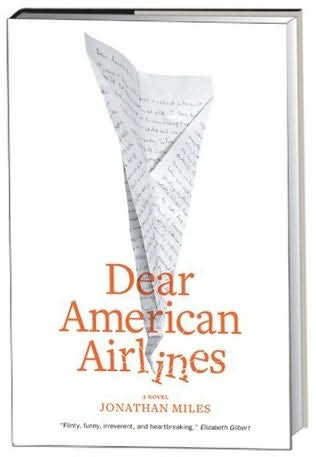
"Dear American Airlines" by Jonathan Miles


"Bennie Ford, a fifty-three-year-old failed poet turned translator, is traveling to his estranged daughter's wedding when his flight is canceled. Stuck with thousands of fuming passengers in the purgatory of O'Hare International Airport, he watches the clock tick and realizes that he will miss the ceremony. Frustrated, irate, and helpless, Bennie does the only thing he can: he starts to write a letter. But what begins as a hilariously excoriating demand for a refund soon becomes a lament for a life gone awry, for years misspent, talent wasted, and happiness lost. A man both sinned against and sinning, Bennie writes in a voice that is a marvel of lacerating wit, heart-on-sleeve emotion, and wide-ranging erudition, underlined by a consistent groundnote of remorse for the actions of a lifetime - and made all the more urgent by the fading hope that if he can just make it to the wedding, he might have a chance to do something right."

My coworker wanted to read this so badly she got it from a library system one county over since she ponied up and got a card for them, too. (Her hubby works in said county, so it's not like they're out wasting gas or anything.) She said it was really good, so when our system bought a copy, I decided to give it a shot. Obviously, she and I have very different tastes, as I found it to be more of an exercise to get through - and this is not a long book by any means, clocking in at a mere 180 pages (the book is also smaller than your standard hardback, so call it more like 150 pages of regular-page-sized text).

I greatly enjoyed Bennie's rants against American Airlines; I think everyone has had at least one stranded-and-weary traveler story, be it an airline fiasco or otherwise. Mine was long ago and involved a car part, one that took an "overnight shipment" to obtain out in New Mexico, a part that had we had a working car would've taken me just an hour or so to obtain on my own. I could very much relate to Bennie's frustration at being stranded when he had an important engagement, especially when his letter to the airlines says that the "delay due to weather" excuse holds no water with him since the sun is out. I think most of us have wanted to demand a refund of our time, our money or both in such situations.

Where the story failed me was in Bennie's tangent ramblings about his own life. To put it bluntly, Bennie is a loser, and he's one of those losers that blames pretty much everyone else for his sad-sack existence. His mother and father should have never met, and even if they did, they should have never ended up together except for the fact that his mother became pregnant with him. His mother didn't really love his father, his father was there but not there (a fact I would highly argue against after reading Bennie's own words), his mother suffered from mental illness and had several "episodes" that put her in the hospital, etc. All of this childhood drama leads Bennie to his current existence, one of basically sleepwalking through life. And we can't forget his own dalliance with Stella, a fellow poet, which resulted in their daughter Stella, she of the aforementioned wedding. Bennie hasn't seen Speck (as he called her during her infancy, probably being the most honest he's been about his feelings for the girl) since she was mere months old; Bennie and Stella Sr had a rollicking argument (one of many) and the ladies moved out to California to live with Stella Sr's parents. Bennie's letter makes it sound like Stella Sr. was very much to blame for the break-up, but keep in mind that Bennie is also a raging alcoholic. Or maybe it would have been better if he was "raging" - mostly he just got drunk and failed to come home. Or be there for Speck's birth. Or be anywhere when he was supposed to be.

Bennie is not what I consider to be a sympathetic character, and as such it took me a long time to get through this minuscule work. I understand what the author was going for, the whole introspective look at one's life when one is forced to spend time waiting and can do little else, but I can't say this is a good book. The author employs some interesting word styling, and there are humorous sections (again when Bennie is ranting against the airline itself) but overall I have to give this one a thumbs down.

Friday, April 3, 2009

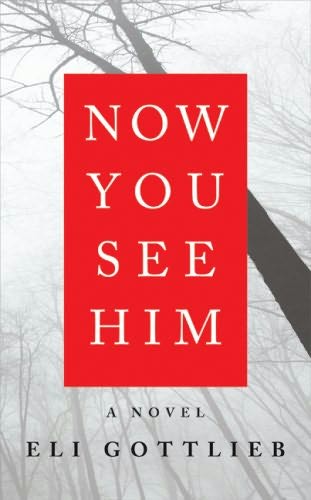
"Now You See Him" by Eli Gottlieb


Nick Framingham is having a difficult time dealing with the death of his childhood friend, Rob Castor. Rob was like a brother to Nick, one of the few kids at school who didn't treat him like the nerd he was. As they got older and went to college, they began to drift apart. Nick got married, had two boys of his own, got a steady job, and settled down in their hometown of Monarch. Rob wrote a bestseller and moved to New York City, bringing a different girl with him every time he returned to the little burg, but eventually dating Kate Pierce, also a writer. Everything seemed to be golden for Rob, right up until the moment that the people of Monarch learned of an unthinkable murder-suicide involving their favorite son.

Nick begins to explore his own life through his memories of Rob, and what he finds isn't pretty. His marriage is on the downhill slide. His job is rote. His boys appear to love their mother more than they love him. In fact, he doesn't seem to have much of a life, which is why he has such a hard time coming to terms with Rob's actions. After all, Rob appeared to have "made it" - how could he throw it all away and in such a horrible fashion?

The truth is, of course, that Rob was not living a fairytale existence. As is typical in real life, people saw what they wanted to see. As a trial unfolds (Kate's parents bring a lawsuit of some sort, one that is never really fully explained), it is revealed that Rob was suffering from writer's block. Not only that, Kate was having an affair with a much older man, one who helped further her own writing career. There are other revelations about Rob and Kate, things that make it all the stranger to the people of Monarch that events unfolded the way they did. And the truth is that Nick is about to learn not only a great deal of information about Rob, but also about himself. Was Rob really who he said he was? Is Nick really who he thinks he is?

This was what I would call a "literary read", a quiet book that requires a bit more attention and thought than some. I like the way the author worked around to the ending, but I can't say that I thought it was necessarily a "good book". I found a few of the revelations of Nick's life to be cliched and could pretty much see them revealed long before they really were. The use of first-person narrative was a wise choice, though; it allows the author to reveal only as much information as our protagonist uncovers. Overall, a decent read, and one to pick up if you're looking for something a bit more substantial than the latest bestseller.

Friday, March 27, 2009

"Fool" by Christopher Moore


I love Christopher Moore. Love, love, love his works. The only one that I hadn't truly laughed out loud while reading was "Fluke" - until now. Yes, there are funny parts of this book. Yes, there is some really good writing in this book. But I must say that I didn't enjoy this book nearly as much as I had anticipated; I expected better from Moore. (Not to mention that my hubby read it first and just laughed himself silly the whole time. Not sure what that says about him...)

"Fool" is Moore's take on King Lear. Yes, that King Lear, the one written by none other than the Bard himself. One of Shakespeare's finest tragedies. As he did in "Lamb", a normally more minor character takes center stage and tells the tale. In this case, that would be Lear's fool, Pocket. Pocket knows all, sees all, and in this case, instigates all. Pocket himself has a sidekick, the fool-in-training Drool, a "natural" (one made not quite right by Nature, but usually just perfectly for a fool's job). All the usual suspects are here - Lear, his daughters Goneril, Regan and Cordelia, the Gloucester gang (the father and his sons, Edgar and Edmund). Also present are characters from other works of Shakespeare's, most notably the witches from "Macbeth". Moore probably lifts lines and/or scenes from a dozen or so of the Bard's works, so you know this is going to be anything but a faithful reworking.

The story is also still a tragedy, beginning with Lear being manipulated by the bastard son Edmund into having his daughters declare how much they love him, with the original results: Goneril and Regan lie through their teeth to get what they want and Cordelia tells the truth, resulting in her banishment. Lear divides his kingdom between the other two snakes, then can't believe how they treat him when he goes to visit. There's treachery around every turn, and of course, an eventual war. Lives are lost and Lear realizes what a fool he has been.

Pocket, being the narrator of this tale, is privy to it all. And maybe that's the problem here - Pocket has an incredibly foul mouth on him. Granted, Moore himself includes a "warning" page in which he tells the reader that "This is a bawdy tale. Herein you will find gratuitous shagging, murder, spanking, maiming, treason, and heretofore unexplored heights of vulgarity and profanity, as well as non-traditional grammar, split infinitives, and the odd wank." I read that warning, so yeah, I should have known what was coming. But... it was a LOT of vulgarity, so much so that I think it distracted from the story. It felt like Moore was relying on the crassness to bring about laughter, and in my case, he failed miserably. I'm used to Moore's sense of humor, and yes, he can and does range into the toilet-humor every now and then, as well as sexual comedy. But "Fool" was just over the top with it. If he had toned that down somewhat, I think I would have enjoyed the book more, perhaps even laughed a bit more. As it was, I found myself thinking that Pocket was the sort of fellow that I'd want to yell at for his lewdness. It made it difficult to sympathize with him, and since he is the narrator, that's not a good thing. Now, please understand that I am in no way a prude. F-bombs don't bother me a bit, talking about sex doesn't phase me, and bloody scenes are not a problem. But this? It's almost like reading a bad actor over-emoting for a scene. That's the best description I can come up with.

I'm hoping that Moore returns to finer form with his next book. Or maybe I'll just do myself a favor and reread "Lamb", undoubtedly one of his best. Yeah, that might wash the stink of "Fool" out of my brain.

Thursday, March 26, 2009

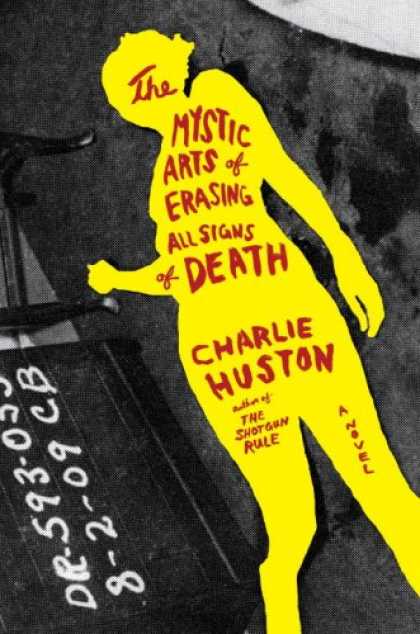
"The Mystic Arts of Erasing All Signs of Death" by Charlie Huston


Wow. Just...wow. I've been reading Huston's stuff for some time now, both his regular mysteries and his Joe Pitt vampire casebooks, so when I learned he had a new book coming out, well, you know I put my name on it right away. And this one? Wow. It is good. Probably one of the best books he's written to date, which is saying quite a lot, seeing as how I'm a huge fan of Joe Pitt. Keep in mind, though, that Huston doesn't write happy touchy-feely works; these are gritty dramas with the some of the most dysfunctional characters you can find on the printed page.

Webster Fillmore Goodhue, slacker extraordinaire, is about to embark on a new career. Web used to be a grade-school teacher, but that career was ended by a senseless tragedy. Web has been slacking ever since, cutting people out of his life a little at a time with his sarcastic wit. OK, mostly alienating them due to his being a complete asshole. However, on this particular day, he's in need of a job, having just destroyed his only friend's cell phone. In order to keep his childhood friend (really, his only friend at this point) Chev from kicking him out of the apartment and leaving him homeless, Web agrees to do some work for Po Sin, the enormous Asian who picks up the hazardous waste from Chev's tattoo parlor on a weekly basis. Po Sin doesn't really let on to the type of work Web will be doing, just that he needs to be report for work early in the morning. Web informs him that he doesn't have any transportation, to which Po Sin tells him "Take the bus". Web can't or won't ride public transportation (you find out why later in a spectacular freak-out moment), so Po Sin sends his other employee, Gabe, to pick up Web before the sun has risen.

What's the job? Cleanup man. Big time cleanup, too; Po Sin owns Clean Team, one of the many crime scene cleanup crews in Los Angeles County. Web's first job? A suicide; guy blew his brains out and left the mess for his daughter to find. Enter Soledad, beautiful young thing that Web is a bit attracted to. Enter the next problem for Web - Soledad calls him later that night and asks him to a hotel room, saying she needs help. Yeah, does she ever. Turns out her worthless half-brother, Jamie, has cut someone in said hotel room and now there's a lot of blood that needs to disappear and fast. Web knows he's being pulled into some heavy stuff, but he does it anyway. And puts himself right in the middle of a smuggling operation gone wrong. Not to mention the turf war between his boss and Morton, another crime scene cleanup guy.

This is definitely Huston at his best. The writing is crisp, the characters are well-developed if not entirely likable at times, and the action is non-stop. Web gets the snot beat out of him on a fairly regular basis, and is in the dark most of the book as to why said snot is being beaten out of him. This is one of the few books of Huston's, though, where I felt the twinge of a happy ending, which was kind of nice. Granted, it's not all sunshine and rainbows, but I liked it. Huston is one of the best authors of modern crime noir out there, and I highly recommend his work.

Monday, March 23, 2009

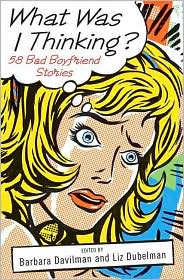
"What Was I Thinking? 58 Bad Boyfriend Stories" edited by Barbara Davilman and Liz Dubelman


Ah, boyfriends. Husbands. Lovers. Men in general. Most of them are wonderful, if you meet them at the right time and right place in your life. But we usually have to go through at least one "bad boyfriend" before Mr. Right; it's so prevalent that it's almost a female rite of passage. Davilman and Dubelman started asking around and yep, just about every woman they talked to had a bad boyfriend story. More importantly, there was usually a defining moment where each woman realized "This is never going to work." The breakup might have happened immediately after that "aha!" moment, or it might have taken a couple months or years for said woman to finally throw in the towel. But they all that distinct "aha" moment where they just knew this guy wasn't going to be the one.

I had requested that our Collection Development department order my branch a copy of this collection, and when it showed up last week on a return, I thought I should read it. Why not? I mean, it was my idea to order it, right? Well, I sat down yesterday afternoon to read some of it - and ended up finishing the whole thing in just a few hours. The stories are addictive in a way I hadn't anticipated, and also very reminiscent of parts of my own life. Some are more literary than others, some are downright hilarious, some are just sad. And the "aha" moments are all so different, everything from a prospective beau mangling the French language in a restaurant to another boyfriend yelling about the "right" size noodles to use in soup. One of the funnier ones is "My Date with Homer", where the date in question starts talking about his childhood and inadvertently plants the seed in the woman's mind that she's on a date with Homer Simpson. Try as she might, she can no longer see him as her date - only as the goofy, doughnut lovin' cartoon father to Bart, Lisa and baby Maggie. Needless to say, she was over him in a hurry!

If you've ever had a relationship gone bad, if you've ever hung in long past that point when you knew you should've gotten out, if you've ever said to yourself "He'll realize how wonderful I am IF...", then you should read this book. You'll laugh, you might cry - but I guarantee that you'll nod your head in complete understanding. We've all had an "aha" moment - and we've all had a bad boyfriend.

Friday, March 20, 2009

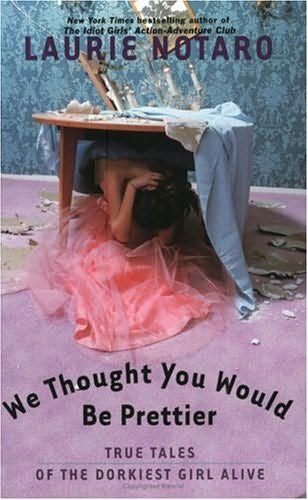
"We Thought You Would Be Prettier" by Laurie Notaro


The subtitle says it all - "True Tales of the Dorkiest Girl Alive". I thought that was me, but after reading Notaro's tales of everyday life, I have to say she's got the crown. Laurie is back with tales of her day-to-day struggle through life, and she's funnier than ever.

Witness "I'm Gonna Kick Your Ass", which is said not to a person, but to his hair. The completely weenie-ass kid at the pet food store, the one who can barely lift a 20 lb bag of dog food into Laurie's cart, has Flippy Hair. Yes, the hair that every girl in the 70s wanted to have - desperately. Laurie is so entranced by this kid's hair that she actually threatens the hair (under her breath, of course). When her hubby demands to see this guy and the damn Flippy Hair, things take an even stranger turn... Never underestimate the power of a good 'do.

I also give her a big "Hell Yeah!" for "Attack of the XL Girl". Laurie is confronted with fat discrimination when shopping with her cute friend in several boutiques. Yeah, fat discrimination - not because they won't wait on her but because these lame-ass stores don't carry anything larger than an 8. Maybe a 10, if you're lucky. Considering that Notaro wears - gasp! - a 14, which is evidently way too fat to shop in said stores. As Notaro points out to several sales clerks, a 14 is pretty much the AVERAGE size of the American female. Even worse? Some stores did have her size, but they kept them stowed away in a back room of the store, much too embarassed that there might be clients that size. I was right there with her in my outrage. I'm sorry, but considering anything about an 8 to be "plus-size" is just evil. If you're going to market your clothing that way, put something on the damn sign outside - "Fashions for the Painfully Thin" or "Clothes for the Very Trim".

The best one of all, though, has to be "Curse of the Squinky Eye". Never heard of the Squinky Eye? I bet you've had one before. Really, you have! Ever have one of your eyelids start twiching on you, sort of spasmodically, not really enough to be noticeable but enough to drive you nuts? Yeah, you've had the Squinky Eye!

Do yourself a favor and find this book, along with the others by Notaro. You won't be sorry!