Lots happening at work, both jobs, and I'm still trying to decide how I feel about things. I won't go into any great detail, as I value my careers - and I don't want to hurt anyone's feelings. But yeah...lots going on.
On the one hand, I'm sort of relieved about some of it. It takes a decision out of my hands, one I've been contemplating for a while. On the other hand, I'm not entirely sure I'm ready for this to be the decision. If that makes any sense, which is probably doesn't without all the facts. And it could be temporary anyway, so who knows what will happen.
The other thing I'm dealing with is jealousy. Well, I guess that's what I'm feeling. I don't really know, as I know I didn't want what someone else got. But I'm still a bit...hm...cranky? about it. I think it's because I was asked to move from what I'd always known - and was still working hard to improve - to a whole new situation, but without any increase in pay. Yep. More responsibilities, more staff, longer drive, new everything - but nothing on the money front. Now, I've always been one of those people that will do what needs to be done. I'm not a slacker. And while I get that the move means management has faith in me and my abilities, and while I'm actually getting to like my new assignment, I'm still feeling...upset? rankled? frustrated? by some other things that are happening. Or not, as the case may be. I think I'm jealous of someone else, but can you be jealous when you didn't want a certain position/assignment in the first place? That's my quandary this morning, trying to define how I feel.
Of course, in the end, it doesn't really matter how I feel. Not about any of this. They're just jobs, in the end, ways to make money to do the thing I really want to do, which is make a life with my hubby. Be able to take a vacation every year. Have some nice weekends off with him. And provide for our furry overlord, aka the cat. And now that I've written that, I realize that is what I should be focused on - making the life I want to have. I can't change anything that's happened, or that's happening. I can only control how I react to things. Which means I should stop thinking so much, get myself another cup of tea, grab my book (currently reading Spring Fever by Mary Kay Andrews - love her!) and sign off the computer for a while. Yes...sounds like plan. :-)
Saturday, May 10, 2014

Friday, May 9, 2014
Birthday Boy
It's Friday, and it's also my hubby's birthday. I took the day off to spend it with him, then ended up agreeing to some work time in the morning (a meeting that's kind of important). He said it was OK, seeing as how he has every intention of sleeping in this morning. Still, I feel a bit bad - I promised to spend the day with him.
I'm still working on balancing work and home. Thanks to his illness 4 years ago, when I almost became a widow, I know how important balance is. Much as I love my job, he comes first. To me, that is what marriage is about - putting your partner first.
Anyway, Happy Birthday to Hubby, and Happy Friday to all!
I'm still working on balancing work and home. Thanks to his illness 4 years ago, when I almost became a widow, I know how important balance is. Much as I love my job, he comes first. To me, that is what marriage is about - putting your partner first.
Anyway, Happy Birthday to Hubby, and Happy Friday to all!
Wednesday, May 7, 2014
Strange book
I'm reading The Uninvited Guests by Sadie Jones, and it finally got interesting. And very weird. It only took almost two hundred pages for that to happen, far more than I usually give a book. Not to mention the novel is only fifty-nine pages longer than that - I've read over two-thirds of the book already! It's very, very British, set in 1912, and involves a somewhat well-to-do family who may be losing their beloved estate, Sterne. It's Emerald's birthday, and there's supposed to be a party attended by a close friend of Emerald's and that friend's mother. However, things do not go as planned; there's a train wreck, and suddenly the family is being asked to house a group from the accident. A mysterious stranger also shows up at Sterne (cliche, but necessary), a man who obviously has some ties to the family - or the house - in some way.
As I said, I usually give books about fifty pages, then give up. I kept going with this one, and for the life of me, I really don't know why. It's been frustrating to read, as the punctuation is driving me batty! Lots of things I've been taught not to do/use when writing, such as colons and semi-colons in dialog. And the commas! Tons and tons of commas, as if the writer took them by the handful and just threw them across the page - and on every page. Maddening - and yet I kept reading.
It's nice that there's been some vindication to keep going. However, I'm not entirely sure where the story will end up. I could still be horribly disappointed, and then realize I spent a good week or so on this book for nothing. Time will tell...
As I said, I usually give books about fifty pages, then give up. I kept going with this one, and for the life of me, I really don't know why. It's been frustrating to read, as the punctuation is driving me batty! Lots of things I've been taught not to do/use when writing, such as colons and semi-colons in dialog. And the commas! Tons and tons of commas, as if the writer took them by the handful and just threw them across the page - and on every page. Maddening - and yet I kept reading.
It's nice that there's been some vindication to keep going. However, I'm not entirely sure where the story will end up. I could still be horribly disappointed, and then realize I spent a good week or so on this book for nothing. Time will tell...
Tuesday, May 6, 2014
Hm...
I finally logged in here for the first time in quite a while. Realized I haven't written or posted anything in, wow, almost 3 months. So I'm once again pondering what to do with this site. Keep trying to do the book review thing? Try something new, go off in a different direction? Maybe more about my work life/library stuff?
Or just shut it down entirely? Since I sort of think no one is really out here reading it anymore anyway.
Hm...
Decision time, I guess.
Or just shut it down entirely? Since I sort of think no one is really out here reading it anymore anyway.
Hm...
Decision time, I guess.
Monday, March 17, 2014
The Sound and the Furry by Spencer Quinn
When Chet and Bernie happen upon a prison work crew that includes Frenchie Boutette, an old criminal pal they sent up the river, getting a new case is the last thing they expect. But Frenchie, who comes from an old Louisiana family full of black sheep, needs help finding his one law-abiding relative, his brother Ralph, a reclusive inventor who has gone missing with his houseboat. Though he's temped to take another job (with a big payday) in Alaska, Bernie decides to set course for the bayous of Louisiana, a trip that will introduce Chet to a world of sights, smells, and tastes that are like nothing he's ever encountered.
Out in bayou country, Chet and Bernie meet the no-good Boutette family and their ancient enemies, the maybe-even-worse Robideaus, and at first it seems as if Ralph's disappearance is connected to a dispute over a load of stolen shrimp. but when Chet uncovers a buried clue, the investigation heads in a dangerous new direction involving the oil business and an impending environmental catastrophe. The more Chet and Bernie discover about Ralph, the more treacherous the job becomes, and soon they're fighting not only Big Oil, but also shadowy black ops figures, a violent biker gang from back home, and Iko - a legendary bayou gator with a seemingly insatiable appetite. Meanwhile, deep under the Gulf, the pressure just keeps building.
With top-notch suspense, humor, and genuine insight into the ways our canine companions think and behave - all set against a rollicking new Louisiana backdrop - The Sound and the Furry will make you howl in delight.
There really isn't much I can say, except it's another great entry in one of my favorite series. I liked that Chet got to describe lots of different smells, especially the ones relating to water. Living in the desert, most of the books don't go into wet smells, just Bernie's rants about the aquifer and such.
I was surprised by one of the relationships, and thought it was very cool of the author to include it. And I love, love, love Chet's way of explaining how alligators smell!
Out in bayou country, Chet and Bernie meet the no-good Boutette family and their ancient enemies, the maybe-even-worse Robideaus, and at first it seems as if Ralph's disappearance is connected to a dispute over a load of stolen shrimp. but when Chet uncovers a buried clue, the investigation heads in a dangerous new direction involving the oil business and an impending environmental catastrophe. The more Chet and Bernie discover about Ralph, the more treacherous the job becomes, and soon they're fighting not only Big Oil, but also shadowy black ops figures, a violent biker gang from back home, and Iko - a legendary bayou gator with a seemingly insatiable appetite. Meanwhile, deep under the Gulf, the pressure just keeps building.
With top-notch suspense, humor, and genuine insight into the ways our canine companions think and behave - all set against a rollicking new Louisiana backdrop - The Sound and the Furry will make you howl in delight.
There really isn't much I can say, except it's another great entry in one of my favorite series. I liked that Chet got to describe lots of different smells, especially the ones relating to water. Living in the desert, most of the books don't go into wet smells, just Bernie's rants about the aquifer and such.
I was surprised by one of the relationships, and thought it was very cool of the author to include it. And I love, love, love Chet's way of explaining how alligators smell!
Tuesday, February 11, 2014
F in Exams: the very best totally wrong test answers by Richard Benson
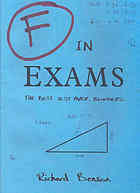
Collected in this book are examples of the more creative and hilarious ways that students have tackled those particularly challenging exam questions.
An incredibly short but funny book, the sort of thing that takes you maybe 30 minutes to read. Just be sure you're among friends if you're reading it around other people, as you will be laughing out loud - and you don't want people thinking you're weird. Also good to be reading around friends as you'll definitely want to share some of the crazy answers. You can tell some of the test takers just didn't care that they didn't know the answer; they have fun making up stuff. Some of the answers are so wrong, they make you weep for the future of our youth. And then there are the misspellings that lead to hilarity, such as the following question/answer:
"What were Jesus' closest group of followers known as?"
"The 12 decibels"
Great for a good laugh. And yes, I completely relate, as I can remember blanking out on a test question or two in my day.
My Planet: Finding humor in the oddest places by Mary Roach

Full disclosure before the review: I listened to this as an audio book, rather than reading it as I usually would (in a physical book). I've recently taken on a new assignment through work, and now have alternating 10 and 16 mile drives back and forth to home. I thought maybe it was time I gave audio books another try, as my previous assignment, at only 4 miles from our apartment, barely gave me time to listen to one song on the radio. After trying this particular title, I can't say I'm sold yet on the idea.
I love Roach, ever since reading her first book Stiff: The curious lives of human cadavers. She's got a really neat way of looking at things, and a nice writing style - never dumbed down, yet always accessible. So it threw me for a loop when I found myself nearly nodding off at this audio version of her short vignettes (and that's definitely not something you want to do while driving!) I think it's not so much the words as the presentation. I've been told that the narrator makes or breaks the audio book, and in this case, well...for myself, it was a case of break. Angela Dawe is, I'm sure, a very nice person, and probably does some excellent work in film, TV, stage, and possibly other audio books (all talents of hers according to her bio on the back of the case). But I think she was the wrong choice for this title. She reminded me a lot of the voice you hear when you call your bank, the automated teller. And that's to her advantage for one of the tracks, "42 minutes" where she recites Roach's typical interaction with the automated voice of her credit card company. For that track, Dawe was perfect. For the others? Not so much.
The other thing I had a hard time with was the fact that 3 of the 4 cds ended in the middle of a story. Why? None of the tracks is particularly long, and when I got to the forth cd, I was shocked that it was over after 16 tracks - most of the other cds ran at 20 or so. Why not take those three interrupted stories and put them on that last disc? I've been told that sometimes the audio publishers do it this way, sometimes they don't. All I know is that I found it weird, distracting, and incredibly inconvenient - I mean, hello! I'm driving and you want me to switch discs all of the sudden?
Overall, I can't say whether the book itself is good or not. I think it is, but I'll reserve that judgment until I read it. In a nice cozy chair, using the voice inside my head. As for the audio version, I didn't care for it. I'll give one more title a try (maybe something in fiction) before I give up, but I'm leaning toward the "I'm just not a fan of audio books" school of reading.
Subscribe to:
Posts (Atom)