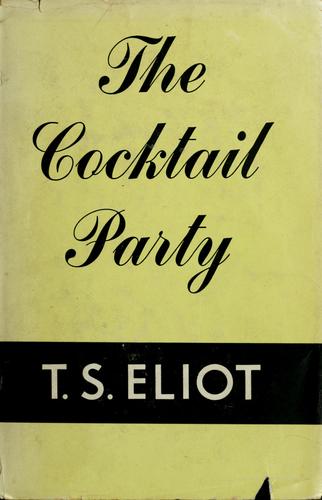
This was one of my attempts at reading more "literary" works, and while I did read it, I have to say that I didn't enjoy it much. I waded my way thru Eliot's "The Wasteland" back in my college days, so I'm not sure why I thought a play by him would be any better. Luckily, it's short.
The whole thing is written in free verse, which I am not a fan of. And as to "what" the play is about, good luck with that, too. It starts off normally enough with a scene set in the drawing room of Edward and Lavinia Chamberlayne. Edward is attempting to entertain a group of friends as his wife, Lavinia, has left him. A strange man who prefers to remain anonymous is also there, and Edward confesses that his wife has left him. The stranger asks if Edward wants to see her again, to which Edward gives thought, then answers "yes", that despite everything, he believes he still loves her. The stranger indicates that Lavinia will appear on the morrow, but that Edward must not ask her any questions.
Some of the previous guests return and are in and out of the next few scenes, all set in the drawing room. When the second act begins, we are at the office of Sir Henry Harcourt-Reilly, an advisor or psychiatrist of sorts. He meets with Edward, then Lavinia comes in, and there's lots of talk about what they want, but in a very existential way. After they agree to give their marriage another chance, the "advisor" meets with one of the party guests, Celia, and tells her that she has a choice about her life, too.
The third act is again in the Chamberlaynes' drawing room and again the same guests are there, all but Celia. Turns out she took one of the path's suggested by Sir Henry and was killed in a foreign country on a mission of mercy (or something like that, I'm still not sure). There's more existential talk about how life is strange, etc, then the play closes.
So what can I say about this? Well, if the reviews on Amazon are any indication, what I can say is that I just don't get this piece at all. It feels like it should be deep and thoughtful, but I mostly just found it boring and confusing, and I don't attribute all that to the free verse. Maybe in the time it was originally published it made more sense, but I just felt like I wasted my time.
Wednesday, December 28, 2011
Saturday, December 10, 2011
"Death Perception" by Victoria Laurie
It took a while for Abby's FBI agent boyfriend, Dutch Rivers, to accept her psychic gifts as the real deal. But these days he knows better than to question Abby's visions. So when his cousin Chase is kidnapped after a bloody shoot-out in a Vegas alleyway, he agrees that her clairvoyant skills could be invaluable, and they both catch the next flight to Sin City. Abby's inner eye insists that Chase is still alive, but nothing else about the case adds up - especially Dutch's reluctance to involve the FBI. On top of everything, Dutch is battling a mysterious illness, and Abby keeps having disturbing dreams that predict his death. Dutch wants Abby to promise that if the investigation goes south, she'll head home to safety, but when the chips are down, Abby won't fold without a fight.
This is the sixth book in Laurie's "Psychic Eye" series, and the first review I've done of any of the books. Basically, they fall under the "cute/cozy/slightly-paranormal mystery" category. They don't take long to read, and they don't take a lot of brain power, either. Yup, my "popcorn" books that I've referred to in past reviews.
This one really isn't any different, except that it is the first one I found myself being somewhat disappointed in, and that seems an odd thing to say, given that my expectations weren't that high in the first place. I've gotten used to Laurie repeating herself when she's giving exposition about how Abby's abilities work, her "crew", what goes through her mind when something is true/false, etc. While it's probably not nearly as noticeable when you have to wait a year between books, it would still be nice if authors could find a way to fill in that backstory in their series' entries without sounding like carbon copies all the time. But I digress....
I know that Abby's visions don't always make sense, and I know that she's not always the sharpest crayon in the box, but hello - the things she "misses" are so obvious, it's not even funny. Take Dutch's "mysterious illness"; I don't hold a medical degree but I knew within the first two scenes what was wrong with the guy! Then there's the issue of her new cellphone; Dutch gave her this gift in the previous book, and while she wasn't thrilled, she was grateful later on because said phone is equipped with a GPS device, meaning it could be used to track someone's location. Got that? Our girl Abby is desperately trying to find Dutch at one point in this book and remembers aha! the cellphone has GPS! But in the very next chapter (after she fails to find said boyfriend), she forgets that the cellphone can be used to track her and gives away her location to the bad FBI guy. Really? Really? I had a hard time buying that myself.
Then there's the issue of the casino. Yep, Abby's "crew" helps her win a sweepstakes, including money and two Mini-Coopers, pretty much the same way that they helped her pick lottery numbers for Dutch's ex-police-partner, Milo. Um, I don't know whether I believe in psychic abilities or not, but I sort of feel like if they are real, there would be a lot more lottery winners. Just saying.
By the time Abby, her sister Cat, and her PI-office-partner Candice, have won those prizes, the believablity factor has dropped several quotients. Honestly, I felt like I was reading about another hapless heroine, the one from New Jersey that's always blowing up cars. There was just too much "madcap adventure" feel about this book, and definitely not enough "plot". I'm hoping when I pick up the next one it's better, or that's the end of the series for me. Guess time will tell.
This is the sixth book in Laurie's "Psychic Eye" series, and the first review I've done of any of the books. Basically, they fall under the "cute/cozy/slightly-paranormal mystery" category. They don't take long to read, and they don't take a lot of brain power, either. Yup, my "popcorn" books that I've referred to in past reviews.
This one really isn't any different, except that it is the first one I found myself being somewhat disappointed in, and that seems an odd thing to say, given that my expectations weren't that high in the first place. I've gotten used to Laurie repeating herself when she's giving exposition about how Abby's abilities work, her "crew", what goes through her mind when something is true/false, etc. While it's probably not nearly as noticeable when you have to wait a year between books, it would still be nice if authors could find a way to fill in that backstory in their series' entries without sounding like carbon copies all the time. But I digress....
I know that Abby's visions don't always make sense, and I know that she's not always the sharpest crayon in the box, but hello - the things she "misses" are so obvious, it's not even funny. Take Dutch's "mysterious illness"; I don't hold a medical degree but I knew within the first two scenes what was wrong with the guy! Then there's the issue of her new cellphone; Dutch gave her this gift in the previous book, and while she wasn't thrilled, she was grateful later on because said phone is equipped with a GPS device, meaning it could be used to track someone's location. Got that? Our girl Abby is desperately trying to find Dutch at one point in this book and remembers aha! the cellphone has GPS! But in the very next chapter (after she fails to find said boyfriend), she forgets that the cellphone can be used to track her and gives away her location to the bad FBI guy. Really? Really? I had a hard time buying that myself.
Then there's the issue of the casino. Yep, Abby's "crew" helps her win a sweepstakes, including money and two Mini-Coopers, pretty much the same way that they helped her pick lottery numbers for Dutch's ex-police-partner, Milo. Um, I don't know whether I believe in psychic abilities or not, but I sort of feel like if they are real, there would be a lot more lottery winners. Just saying.
By the time Abby, her sister Cat, and her PI-office-partner Candice, have won those prizes, the believablity factor has dropped several quotients. Honestly, I felt like I was reading about another hapless heroine, the one from New Jersey that's always blowing up cars. There was just too much "madcap adventure" feel about this book, and definitely not enough "plot". I'm hoping when I pick up the next one it's better, or that's the end of the series for me. Guess time will tell.
Thursday, December 8, 2011
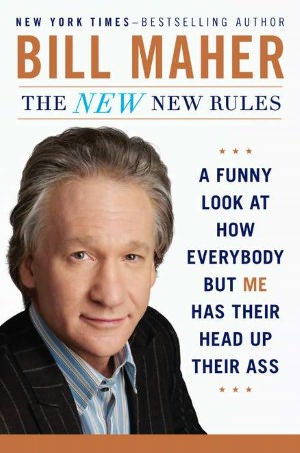
"The New New Rules: A funny look at how everybody but me has their head up their ass" by Mill Maher
You have to say one thing for Bill Maher: the man speaks his mind and makes no apologies for doing so.
If you're not familiar with the sometimes-caustic, liberal host of HBO's Real Time, then you most likely picked up this book by mistake. I used to watch Maher when his show was still on "regular" television, before he spoke up about something, got everyone's panties in a twist, and had to go back to HBO. Yes, that should tell you something right there: he used to be on cable, moved to late-night TV, then went back to cable. Maher's guests were always an interesting bunch. I can remember one show that included Marilyn Manson, Florence Henderson, and two other guests. I don't remember who the other two were, but I do remember that one of them was a religious nut-job, and I say that in the nicest way possible. It was quite a sight to see Manson sitting there calmly trying to debate said nut-job and Mrs. Brady had to be the one to tell this lady to please be quiet and let the young man have a chance to speak. Surreal!
Anyway, Maher covers most of the same ground he did in his previous book and on his show. In fact, he admits in the foreword that the longer, more "philosophical" pieces are basically straight from the show, although not all made it to air. The short musings are funnier, in my humble opinion, and they are definitely short. This is the sort of book that you can pick up and digest little nuggets, akin to the evil McDonald's Chicken Nuggets that Maher likes to make you feel bad about eating.
Prime example (and one near & dear to my heart, as I am now a rebel at the ripe old age of almost 44!)
Tat Patrol: Now that everyone has a tattoo, it will now be considered rebellious to not have a tattoo. Seriously. I think the Jonas Brothers have tattoos now. I'm sure Mitt Romney is all inked up. Betty White has one across her back that says "F**k the Police" - that I know for sure.
Now, as funny as I found a lot of Maher's musings, I have to admit that I was a bit disappointed with him at times, too. He's turned into the "super-left" guy, just as Dennis Miller has turned into the "super-right", and I find that sad. Yes, the Republicans have screwed up things in this country - but so have the Democrats. Yes, there should be higher taxes to help get us out of the national debt, and definitely yes, corporations that manage to pay absolutely no taxes each and every year need to be stopped. But the Democrats went mad with power when they were in the majority, and rather than trying to help the country a little, they "helped" us a lot - and a lot of us really didn't deserve such help. I am all for lending a helping hand, but I grew a bit tired of watching the Democrats give us all handouts. I do agree with Maher when he asks what has happened to us as a country; he feels that we've become too accustomed to sitting around and waiting for the government to "save us". Well, guess what folks? Congress is nothing more right now than a huge daycare full of 2-year-olds that need a nap and refuse to agree on anything. It's going to be up to us, the citizens, to pull ourselves out of this mess - and that won't happen if we're squalling right along with the Big Boys.
All in all, a fun read. But I do wish we'd see a little more "middle" humor from our comedians, because I truly believe that's where most Americans stand - in the middle.
If you're not familiar with the sometimes-caustic, liberal host of HBO's Real Time, then you most likely picked up this book by mistake. I used to watch Maher when his show was still on "regular" television, before he spoke up about something, got everyone's panties in a twist, and had to go back to HBO. Yes, that should tell you something right there: he used to be on cable, moved to late-night TV, then went back to cable. Maher's guests were always an interesting bunch. I can remember one show that included Marilyn Manson, Florence Henderson, and two other guests. I don't remember who the other two were, but I do remember that one of them was a religious nut-job, and I say that in the nicest way possible. It was quite a sight to see Manson sitting there calmly trying to debate said nut-job and Mrs. Brady had to be the one to tell this lady to please be quiet and let the young man have a chance to speak. Surreal!
Anyway, Maher covers most of the same ground he did in his previous book and on his show. In fact, he admits in the foreword that the longer, more "philosophical" pieces are basically straight from the show, although not all made it to air. The short musings are funnier, in my humble opinion, and they are definitely short. This is the sort of book that you can pick up and digest little nuggets, akin to the evil McDonald's Chicken Nuggets that Maher likes to make you feel bad about eating.
Prime example (and one near & dear to my heart, as I am now a rebel at the ripe old age of almost 44!)
Tat Patrol: Now that everyone has a tattoo, it will now be considered rebellious to not have a tattoo. Seriously. I think the Jonas Brothers have tattoos now. I'm sure Mitt Romney is all inked up. Betty White has one across her back that says "F**k the Police" - that I know for sure.
Now, as funny as I found a lot of Maher's musings, I have to admit that I was a bit disappointed with him at times, too. He's turned into the "super-left" guy, just as Dennis Miller has turned into the "super-right", and I find that sad. Yes, the Republicans have screwed up things in this country - but so have the Democrats. Yes, there should be higher taxes to help get us out of the national debt, and definitely yes, corporations that manage to pay absolutely no taxes each and every year need to be stopped. But the Democrats went mad with power when they were in the majority, and rather than trying to help the country a little, they "helped" us a lot - and a lot of us really didn't deserve such help. I am all for lending a helping hand, but I grew a bit tired of watching the Democrats give us all handouts. I do agree with Maher when he asks what has happened to us as a country; he feels that we've become too accustomed to sitting around and waiting for the government to "save us". Well, guess what folks? Congress is nothing more right now than a huge daycare full of 2-year-olds that need a nap and refuse to agree on anything. It's going to be up to us, the citizens, to pull ourselves out of this mess - and that won't happen if we're squalling right along with the Big Boys.
All in all, a fun read. But I do wish we'd see a little more "middle" humor from our comedians, because I truly believe that's where most Americans stand - in the middle.
Saturday, November 26, 2011
"Sandman Slim" by Richard Kadrey
Life sucks, and then you die. Or, if you're James Stark, you spend eleven years in Hell as a hitman before finally escaping, only to land back in the hell-on-earth that is Los Angeles. Now Stark's back, and ready for revenge. And absolution, and maybe even love. But when his first stop saddles him with an abusive talking head, Stark discovers that the road to absolution and revenge is much longer than you'd expect, and both Heaven and Hell have their own ideas for his future. Resurrection sucks. Saving the world is worse. Darkly twisted, irreverent, and completely hilarious, [this book] is the breakthrough novel by an acclaimed author.
First problem is this: I have no idea who Richard Kadrey is. The dust jacket blurb says he's an "acclaimed author", but this was my first introduction to him, and from what I've gathered from some of the reviews, the first time most people have heard of him. But I think he's well on his way to making it bigger, as this book is pretty awesome. It's also getting attention from other writers, as I recently read a blog post by Jocelyn Drake saying how wonderful this book is and go out and read it for myself.
Yep, she was right.
So was the hubby, who devoured it first. (He's also breezed right thru the second installment, leaving me behind in his biblionic dust - and yes, I just made up that word, "biblionic". Pretty cool, huh?)
To tell you much about the book would be to give things away, but I will tell you that it reminded me a bit of Jim Butcher's Harry Dresden series. The comparisons are inevitable in a way: rough and tumble magician pissing off everyone around him, and let's not forget about the talking head. Granted, in "Slim" the head is the direct result of actions taken by Stark, whereas Bob is more of a mentor/contemporary of Harry's. Still... But "Sandman Slim" is darker, which I liked. There are mysteries of all sorts here to be solved, not the least of which is, who is James Stark? He might not like some of the answers.
My biggest complaint about this book is the editing/proofreading, or what at times appears a complete lack of. There are words missing, wrong words being used, and sometimes misspellings as well. It's to be expected that there will be little things missed on occassion, but to have this many of them missed starts to feel like someone has dropped the ball. And now that I do some proofreading myself (yep, for profit!) I really, really notice when things like this happen. For example, read the following, and perhaps read it aloud for full effect: "No. Wild Bill told my great-granddad about it. It's where I take you down the river. Someplace the ground is soft and wet. I break your arms and legs. You fingers and toes. Your neck and back. I dig a hole in the wet, soft ground, put you inside, and fill it back up. Then I have a cigarette and wait for you to dig your way out." In the space of less than 100 pages, I immediately picked out this and four more errors, and those were just the ones that I noticed right off the bat. I know there were more in the beginning of the book, but I wasn't really looking for them.
I will definitely be looking for the next installment, though, as this was a pretty good read. I'm anxious to see what happens to Sandman Slim next.
First problem is this: I have no idea who Richard Kadrey is. The dust jacket blurb says he's an "acclaimed author", but this was my first introduction to him, and from what I've gathered from some of the reviews, the first time most people have heard of him. But I think he's well on his way to making it bigger, as this book is pretty awesome. It's also getting attention from other writers, as I recently read a blog post by Jocelyn Drake saying how wonderful this book is and go out and read it for myself.
Yep, she was right.
So was the hubby, who devoured it first. (He's also breezed right thru the second installment, leaving me behind in his biblionic dust - and yes, I just made up that word, "biblionic". Pretty cool, huh?)
To tell you much about the book would be to give things away, but I will tell you that it reminded me a bit of Jim Butcher's Harry Dresden series. The comparisons are inevitable in a way: rough and tumble magician pissing off everyone around him, and let's not forget about the talking head. Granted, in "Slim" the head is the direct result of actions taken by Stark, whereas Bob is more of a mentor/contemporary of Harry's. Still... But "Sandman Slim" is darker, which I liked. There are mysteries of all sorts here to be solved, not the least of which is, who is James Stark? He might not like some of the answers.
My biggest complaint about this book is the editing/proofreading, or what at times appears a complete lack of. There are words missing, wrong words being used, and sometimes misspellings as well. It's to be expected that there will be little things missed on occassion, but to have this many of them missed starts to feel like someone has dropped the ball. And now that I do some proofreading myself (yep, for profit!) I really, really notice when things like this happen. For example, read the following, and perhaps read it aloud for full effect: "No. Wild Bill told my great-granddad about it. It's where I take you down the river. Someplace the ground is soft and wet. I break your arms and legs. You fingers and toes. Your neck and back. I dig a hole in the wet, soft ground, put you inside, and fill it back up. Then I have a cigarette and wait for you to dig your way out." In the space of less than 100 pages, I immediately picked out this and four more errors, and those were just the ones that I noticed right off the bat. I know there were more in the beginning of the book, but I wasn't really looking for them.
I will definitely be looking for the next installment, though, as this was a pretty good read. I'm anxious to see what happens to Sandman Slim next.
"My Formerly Hot Life: dispatches from just the other side of young" by Stephanie Dolgoff
When men stop making lecherous catcalls and Spanx get comfortable in your lingerie drawer, when marketers target you for Activia instead of $200 premium denim, when you have to start wearing makeup to get the "I'm not wearing any makeup" glow and are "ma'amed" outside the Deep South, it may dawn on you that somehow you have crossed an invisible line: You are not the young, relevant, in-the-mix woman you used to be. But neither are you old, or even what you think of as middle-aged. You are no longer what you were, but not quite sure what you are. Stephanie Dolgoff calls this stage of a woman's life "Formerly," the state of mind and body she herself is in now: Her roaring twenties are behind her, but she's not in hot flash territory, either. [This book], showcasing Dolgoff's wacky and wise observations about this little-discussed flux time, demonstrates that becoming a Formerly is intensely poignant if you're paying attention, and hilarious even if you're not. From fashion to friendship, beauty to body image, married sex to single searching, mothering to careering (or both), Dolgoff reveals the upside to not being forever 21 - even as you watch the things you once thought were so essential to a happy life go the way of the cassette tape. You may be formerly thin, formerly cool, formerly (seemingly) carefree, formerly cutting-edge, but in reading [this book] you are reminded that you are finally more comfortable in your skin (formerly obsessed with your weight), finally following your instincts (formerly ruled by the opinions of others), and finally happy with where you are) formerly focused on the guy or job you thought would take you where you thought you should be). While you may no longer be as close to the media-machine-generated idea of fabulous, you can do many, many more things fabulously.
OK, full disclosure - I have never thought of myself as "hot". Cute, maybe even kind of pretty at times, but the word "hot" has never been used by myself when describing my own person. So what's a "not-now-not-ever" hot lady like myself doing with a book like this? Laughing my {bleeping} butt off, that's what.
The territory here feels oh-so-familiar, as I am now in my early 40s. I totally understand where Dolgoff is coming from and feel her pain at realizing that I no longer fit in the 25-35 age category on most questionnaires. Sad but true - I'm one of those middle-aged women who certainly don't feel middle-aged. The only section I didn't relate too very well was the one about parenting, but that's because my husband and I are childless by choice. The rest of it, though, could have been written by yours truly at times.
For example, I love her take on all the new gadgets on the market. Like myself, she uses some of them, but isn't what you would call a "tech-geek", and for good reason. She explains: "I'm not fearful or dismissive of technology, even if I don't see it as the extension of self that younger people often do. The problem is, I am barely able to find the time and the presence of mind to learn what I need to know to make the technology I already have do the minimal things I ask it to do, let alone explore the next generation of gizmo and all of its many features..." EXACTLY! I finally broke down and bought a computer for home use, and yes, I have now had a cell phone for about 18 months, but I still don't fully embrace either one. The computer is basic and has what I need (and a lot that I don't); the phone is a pay-as-you-go not-so-smartphone that allows me to call my friends and send text messages. I think it would let me access the Internet if I could/would take the time to figure it out, but honestly, I don't care. I don't need it to take pictures, compare prices on goods, or any of the other multitude of things that others use their fancy phones to do. In fact, at one point before obtaining this model, I figured if I ever did buy one, it would be a Jitterbug model, the one designed for "older folks".
The other topic she covers at length is also one I relate to quite well, the issue of body image. She talks about TBMFU, also known as The Big Metabolic F*ck You, the sad fact that your metabolism at some point will turn on you like a rabid dog and cause you to gain weight in places you didn't even know it was possible to gain weight. And while it is frustrating to realize you can no longer eat the whole pint of Ben & Jerry's without seeing it on your saddlebags post-haste, you are also at that age where you realize there are bigger concerns in your life than the size of your thighs. She talks here about hearing a comment at a party made about still-stick-thin "formerly" women; the commenter says that they are very restrictive in their calorie intake. Dolgoff later says "It takes effort to not eat when you're hungry, to constantly be figuring what you can and cannot put in your mouth based on whether or not you think it'll make you fat or what you may or may not want to eat later. Doing so takes up buckets of mental energy, which can be in short supply when you're already overextended, stressed out and multitasking." I can attest to this myself; no, I've never been one to be severely restrictive with my food, but taking the time to be "on a diet" and think about food all the time is exhausting. I'd rather just try to cut back on all my portion sizes and eat what I want, maybe take an extra walk around the block, than do the diet thing. And I know I have more important things to focus on in my life than my waist size or the number on the bathroom scale.
If you're nearing your 40s, are firmly in them, or have left them behind in the dust, I highly recommend this book. It's so nice to know that there are others feeling this same way, and that we can think of ourselves as smarter, if not "hotter".
OK, full disclosure - I have never thought of myself as "hot". Cute, maybe even kind of pretty at times, but the word "hot" has never been used by myself when describing my own person. So what's a "not-now-not-ever" hot lady like myself doing with a book like this? Laughing my {bleeping} butt off, that's what.
The territory here feels oh-so-familiar, as I am now in my early 40s. I totally understand where Dolgoff is coming from and feel her pain at realizing that I no longer fit in the 25-35 age category on most questionnaires. Sad but true - I'm one of those middle-aged women who certainly don't feel middle-aged. The only section I didn't relate too very well was the one about parenting, but that's because my husband and I are childless by choice. The rest of it, though, could have been written by yours truly at times.
For example, I love her take on all the new gadgets on the market. Like myself, she uses some of them, but isn't what you would call a "tech-geek", and for good reason. She explains: "I'm not fearful or dismissive of technology, even if I don't see it as the extension of self that younger people often do. The problem is, I am barely able to find the time and the presence of mind to learn what I need to know to make the technology I already have do the minimal things I ask it to do, let alone explore the next generation of gizmo and all of its many features..." EXACTLY! I finally broke down and bought a computer for home use, and yes, I have now had a cell phone for about 18 months, but I still don't fully embrace either one. The computer is basic and has what I need (and a lot that I don't); the phone is a pay-as-you-go not-so-smartphone that allows me to call my friends and send text messages. I think it would let me access the Internet if I could/would take the time to figure it out, but honestly, I don't care. I don't need it to take pictures, compare prices on goods, or any of the other multitude of things that others use their fancy phones to do. In fact, at one point before obtaining this model, I figured if I ever did buy one, it would be a Jitterbug model, the one designed for "older folks".
The other topic she covers at length is also one I relate to quite well, the issue of body image. She talks about TBMFU, also known as The Big Metabolic F*ck You, the sad fact that your metabolism at some point will turn on you like a rabid dog and cause you to gain weight in places you didn't even know it was possible to gain weight. And while it is frustrating to realize you can no longer eat the whole pint of Ben & Jerry's without seeing it on your saddlebags post-haste, you are also at that age where you realize there are bigger concerns in your life than the size of your thighs. She talks here about hearing a comment at a party made about still-stick-thin "formerly" women; the commenter says that they are very restrictive in their calorie intake. Dolgoff later says "It takes effort to not eat when you're hungry, to constantly be figuring what you can and cannot put in your mouth based on whether or not you think it'll make you fat or what you may or may not want to eat later. Doing so takes up buckets of mental energy, which can be in short supply when you're already overextended, stressed out and multitasking." I can attest to this myself; no, I've never been one to be severely restrictive with my food, but taking the time to be "on a diet" and think about food all the time is exhausting. I'd rather just try to cut back on all my portion sizes and eat what I want, maybe take an extra walk around the block, than do the diet thing. And I know I have more important things to focus on in my life than my waist size or the number on the bathroom scale.
If you're nearing your 40s, are firmly in them, or have left them behind in the dust, I highly recommend this book. It's so nice to know that there are others feeling this same way, and that we can think of ourselves as smarter, if not "hotter".
"In The Land of Long Fingernails: a gravedigger's memoir" by Charles Wilkins
As a student during the summer of 1969, Charles Wilkins took a job as a gravedigger in a vast corporate cemetery in the east end of Toronto. The bizarre-but-true events of that time - a gravediggers' strike, the unearthing of a victim of an unsolved murder and a little illegal bone-shifting - play out among a Barnumesque parade of mavericks and misfits in this macabre and hilarious memoir. Amid relentless gallows humour and the inevitable reminders of what it is, finally, to be be human, Wilkins provides an unforgettable insider's view of a morbidly fascinating industry. {This} is a story of mortality, materialism, friendship and sexuality... and the gradual coming-of-age of an impressionable young man.
I had originally put this title on a TBR list for my hubby, as he loves this sort of thing. We've both read a couple of interesting books about death and the funeral industry, so this was a no-brainer. When I finally got it for him (the book, not a funeral), he flew through it and told me lots of little tidbits, enough that my interest was piqued. I finally finished it this morning, no small feat thanks to a busy work schedule, in-laws in for the Thanksgiving holiday, and general weariness of late which has had me falling asleep with only one, if any, chapters read at night.
The book is well-written, and yes, it is very interesting. The title is a bit of a misnomer, though, as Wilkins was not an "official" gravedigger. That title belonged to the only two union men on the crew, Peter and Hogjaw. When the strike hits (in the middle of summer, no less), the dead cannot be buried, as there are no other gravediggers available. Yes, Wilkins and his non-union co-workers could have done the job, but they are legally bound not to. Coffins with corpses are loaded into one of the buildings that has been outfitted with industrial A/C units; even so, after almost 3 weeks (and some 50+ corpses), the place is really starting to smell. Wilkin's job mostly consisted of cemetery maintenance, such as mowing lawns, clipping the parts that couldn't be mowed, filling in "sinkers" (plots that have settled enough to be noticeable by visiting mourners) and other such minutia that make a cemetery a place of peace.
There are several characters here, though. Peter and Hogjaw are the union guys. Luccio Pucci is an Italian in Canada on a visa (which has all but expired); he's a philosopher, writer, and in need of a better-paying, "real", job. He has hopes of becoming an economist, but seems to put off every potential employer. Fred is the one-armed groundskeeper, a quiet man of dignity who has perhaps one of the scariest brushes with death, as it is all too common and could happen to anyone. There's David, a grandson of the gravediggers' boss, Scotty. Scotty is the biggest character of all, something of a stereotype, but probably all too real. He drinks Scotch (of course) but it must be Cutty Sark and none other. He's brusque with his crew, yelling at them over the smallest details, and yet he can be sensitive at times. And like all human beings, he has a private life that his crew eventually learn of, one that explains his alcoholism to a point, one that makes him all the more human.
It's a good book, entertaining despite its topic. Some will find the gallows humour off-putting, I'm sure. But lots of professions use that sort of humour to deal with death: police, emergency personnel, etc. It's how you might react if you were the one faced with death on a daily basis. But the book isn't really about death - it's about life. And in the end, how you live it is more important than how you leave it.
I had originally put this title on a TBR list for my hubby, as he loves this sort of thing. We've both read a couple of interesting books about death and the funeral industry, so this was a no-brainer. When I finally got it for him (the book, not a funeral), he flew through it and told me lots of little tidbits, enough that my interest was piqued. I finally finished it this morning, no small feat thanks to a busy work schedule, in-laws in for the Thanksgiving holiday, and general weariness of late which has had me falling asleep with only one, if any, chapters read at night.
The book is well-written, and yes, it is very interesting. The title is a bit of a misnomer, though, as Wilkins was not an "official" gravedigger. That title belonged to the only two union men on the crew, Peter and Hogjaw. When the strike hits (in the middle of summer, no less), the dead cannot be buried, as there are no other gravediggers available. Yes, Wilkins and his non-union co-workers could have done the job, but they are legally bound not to. Coffins with corpses are loaded into one of the buildings that has been outfitted with industrial A/C units; even so, after almost 3 weeks (and some 50+ corpses), the place is really starting to smell. Wilkin's job mostly consisted of cemetery maintenance, such as mowing lawns, clipping the parts that couldn't be mowed, filling in "sinkers" (plots that have settled enough to be noticeable by visiting mourners) and other such minutia that make a cemetery a place of peace.
There are several characters here, though. Peter and Hogjaw are the union guys. Luccio Pucci is an Italian in Canada on a visa (which has all but expired); he's a philosopher, writer, and in need of a better-paying, "real", job. He has hopes of becoming an economist, but seems to put off every potential employer. Fred is the one-armed groundskeeper, a quiet man of dignity who has perhaps one of the scariest brushes with death, as it is all too common and could happen to anyone. There's David, a grandson of the gravediggers' boss, Scotty. Scotty is the biggest character of all, something of a stereotype, but probably all too real. He drinks Scotch (of course) but it must be Cutty Sark and none other. He's brusque with his crew, yelling at them over the smallest details, and yet he can be sensitive at times. And like all human beings, he has a private life that his crew eventually learn of, one that explains his alcoholism to a point, one that makes him all the more human.
It's a good book, entertaining despite its topic. Some will find the gallows humour off-putting, I'm sure. But lots of professions use that sort of humour to deal with death: police, emergency personnel, etc. It's how you might react if you were the one faced with death on a daily basis. But the book isn't really about death - it's about life. And in the end, how you live it is more important than how you leave it.
Sunday, November 13, 2011
"What? Are These the 20 Most Important Questions in Human History - Or Is This a Game of 20 Questions?" by Mark Kurlansky
What is What? Has Mark Kurlansky drawn on philosophy, religion, literature, politics - indeed, all of civilization - to ask the twenty most important questions in human history, or has he given us a really smart, impossibly amusing game of twenty questions? In What?, Kurlansky considers the work of Confucius, Plato, Stein, Shakespeare, Descartes, Nietzsche, Freud, Hemingway, de Gaulle, Woolf, Dickinson, and others, distilling the deep questions of life to their sparkling essence. What? supplies endless fodder for thoughtful conversation, but also endless opportunity to ponder and be challenged - and entertained - by these questions in refreshingly original ways. As Kurlansky says: In a world that seems devoid of absolute certainties, how can we make declarative statements? Without asking the questions, how will we ever get to the answers? Why are we here? Why do we die? What is death? What does it mean the outer space is infinite, and what is after infinity? What is the significance of bird flight, why does matter decay, and how is our life different from that of a mosquito? Is there an end to these questions or is questioning as infinite as space? With Kurlansky's striking black-and-white woodcut illustrations throughout, this terrifically witty, deeply thought-provoking book is a tour de force that packs a tremendous wallop in a deliciously compact package.
This really is a most interesting, and yes, thought-provoking, little book. I'm not one for deep philosophical discussions (and I will admit that often attempting to read about said philosophers makes me feel....um....less than intelligent), but this book had me thinking about a lot of things. Perhaps the biggest question is this: how talented an author must you be to write an entire book in questions? Seriously. Every single sentence in this book is a question, meaning that Kurlansky starts with one question and answers all of the questions he asks with - you got it - more questions. The only time a question is not asked is when he writes his final word of the piece, and that is a one-word answer. I won't tell you what the answer is; you must read it for yourself.
Trust me, you'll enjoy it. I even found myself going back to reread parts of the book, it was that much fun. And it's only about 77 pages long, so you can digest it in one sitting, if you choose. I think it would work best to read each question, then set the book aside and really think about what he's written. I would love to get a copy of this and send it to my dad, who taught me in my youth "you never learn anything if you don't ask questions". It was a lesson he came to regret sometimes, as I asked lots of questions when I was a little girl. But as Kurlansky points out, we seem to stop asking those questions as we age; we just go along with what others tell us, or accept that things are what they are because we feel powerless to change them. Given all that the world has been through in the past few years, I think he's onto something; I think we should start asking a lot more questions, both of the outside world, and most importantly, of ourselves.
This really is a most interesting, and yes, thought-provoking, little book. I'm not one for deep philosophical discussions (and I will admit that often attempting to read about said philosophers makes me feel....um....less than intelligent), but this book had me thinking about a lot of things. Perhaps the biggest question is this: how talented an author must you be to write an entire book in questions? Seriously. Every single sentence in this book is a question, meaning that Kurlansky starts with one question and answers all of the questions he asks with - you got it - more questions. The only time a question is not asked is when he writes his final word of the piece, and that is a one-word answer. I won't tell you what the answer is; you must read it for yourself.
Trust me, you'll enjoy it. I even found myself going back to reread parts of the book, it was that much fun. And it's only about 77 pages long, so you can digest it in one sitting, if you choose. I think it would work best to read each question, then set the book aside and really think about what he's written. I would love to get a copy of this and send it to my dad, who taught me in my youth "you never learn anything if you don't ask questions". It was a lesson he came to regret sometimes, as I asked lots of questions when I was a little girl. But as Kurlansky points out, we seem to stop asking those questions as we age; we just go along with what others tell us, or accept that things are what they are because we feel powerless to change them. Given all that the world has been through in the past few years, I think he's onto something; I think we should start asking a lot more questions, both of the outside world, and most importantly, of ourselves.
Subscribe to:
Posts (Atom)