Saturday, May 31, 2008

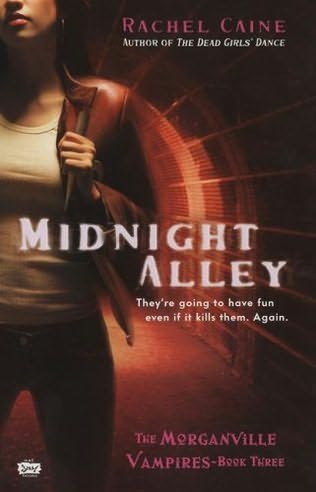
"Midnight Alley" by Rachel Caine


The third book in Caine's Morganville Vampires series is a marked improvement over the second book. The action slows down just a bit, and there's a lot more crucial information imparted to the reader, both about the town of Morganville and about young Claire Danvers herself. If you haven't been keeping up with this young adult series, I would recommend reading the first two books. Caine does a fairly good job of bringing new readers up to speed, but it never hurts to start at the beginning. Also, being YA titles, none of the books is very long, so they're easy, quick reads.

In this installment, Claire is under Amelie's protection; this move by Claire was supposed to bring safety to her and those living in the Glass House. However, it would seem that not even the founder of Morganville has quite that much power. In addition, Claire now has different college courses to take thanks to Amelie, very interesting classes in history and science. She also has a special assignment, one that means working with a very old, and very insane, vampire. There's a secret about Morganville that Amelie is working hard to protect, a secret that she would very much like to change, too.

As for Claire's roommates, well, there's a bit of friction there. Michael and Shane, best friends for years, are now at each other's throats quite often. This might be due to Michael's new "lifestyle choice", the one he made in the second book. Eve is worried about her brother, and she should be. There's a very good chance that he's been killing human girls around Morganville, and he wouldn't lose any sleep over Eve's death. And then there's Monica Morrell, Claire's arch nemesis from the first two books; she suddenly wants to be the best of friends with Claire.

As I said, there's a bit of action in this book, but not nearly as much as book two, and certainly not at the breakneck speed of that work. I found myself quite interested in Claire's new "work" with the old vampire, and I loved that she sees now that everything is not quite so black and white. I'm hoping the fourth book will continue in this vein and not rely on the action sequences so much.

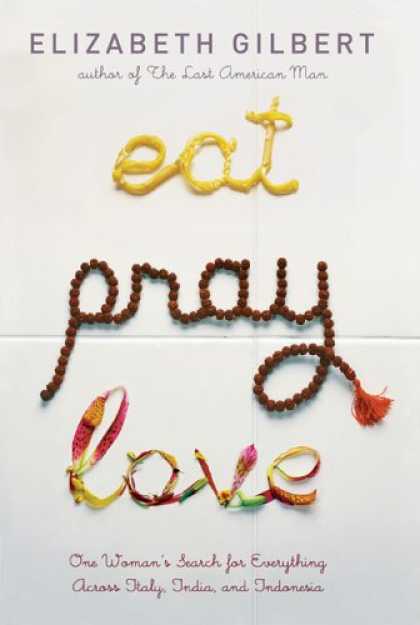
"Eat, Pray, Love" by Elizabeth Gilbert


Yes, this was an Oprah book. Yes, this has become somewhat of an overnight sensation. And yes, there is now a fairly good amount of backlash against the author, for various reasons, by different people. None of these were deciding factors in why I read this book.

We got this title in our branch after the library system I work for purchased additional copies to handle the demand by our patrons. It had crossed the desk several times, and each time, I would read the dust jacket blurb and think, "Hmmm..... might be an interesting read at some point." Well, one day I noticed it on our shelf and thought that's it, I'm checking this thing out. I mean, after looking at it that much, after apparently being drawn to it in that manner, it seemed the thing to do, right?

And I'm glad I did. I personally enjoyed this book a lot. Having said that, I also didn't take it for anything other than a memoir, perhaps a bit of a travel guide at best. I think the backlash comes from those who feel that the author is trying to say "This is how to find your inner peace" - which she never did. She told how she found her inner peace, but I never did see or read anything that would lead me to believe she was advocating her method of enlightenment to the general public. And yes, this book is definitely self-absorbed chatter from the author - because the book is about her life. Isn't that what a memoir is? Sigh.

If you love descriptiveness, pick up and read the section on Italy at the very least. I fell in love all over again with that country, much as I did after reading Frances Mayes' "Under the Tuscan Sun". I enjoyed all three sections of Ms. Gilbert's book, and I found something in each of them that I could relate to. I think there's a little something for everyone in this book, again, if you don't take it too seriously. Read it as the memoir it is, not as a self-help manual.

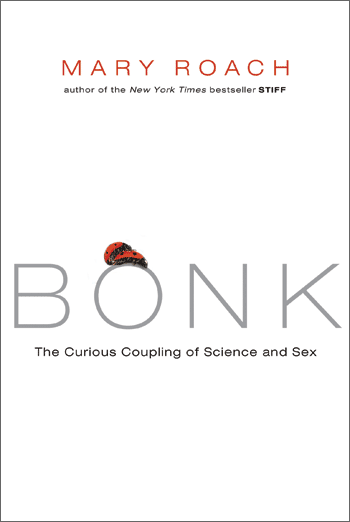
"Bonk: The Curious Coupling of Science and Sex" by Mary Roach


Mary Roach is back! I'm very pleased to recommend her latest work, "Bonk". It's almost as good as her first book, "Stiff: The Curious Lives of Cadavers", and once again, I was entertained, amused, and instructed. Not every work of non-fiction can lay claim to that!

"Bonk" is basically about those brave, yet often shunned, individuals that study sex from a scientific view. After all, the science of intercourse has come a long way. For example, it was once thought that the cervix actually sucked in and clamped down on the penis during sex, and that if this docking sort of movement was unsuccessful, couples would be unable to conceive. Thus, the woman was blamed for any infertility problems, seeing as how it was her cervix that failed to hold on tightly enough!

Almost as interesting as the researchers are the test subjects. After all, what sort of woman agrees to let herself be filmed by a penis-cam? What sort of couple agrees to have electrodes and monitors attached to themselves during "the act"? What couple can manage to have really good sex inside an MRI tube so that scientists can actually observe the sex organs during, well, sex? The answer is very brave people, and often, the working girl (back in the day, that is).

I learned how a man obtains, and keeps, an erection. It's not nearly as simple as you'd think, and it's not really the obtaining as much as the maintaining that's a problem for most men. I learned that much of the male member is hidden inside the body, too; the author explains that after scientists did several of the MRI tests, they realized that most men can easily claim to be 10 inches long. You just can't see a lot of that 10 inches.

I learned that women are complicated, that most do not achieve any sort of orgasm with "straight, missionary-style" sex, and that women often ignore their bodies own arousal signals. So even though we say women are stimulated by talking, connecting, etc, we really are aroused by visual cues as well - we just don't pay attention to our own cues. How sad! There's also a lot of talk about hormones, pheromones, and the like.

If you've ever been curious about how it all works, this is a great book for you. If you've ever just been curious, this is also a great book for you!

Thursday, May 29, 2008

"Half the Blood of Brooklyn" by Charlie Huston


"There's only so much room on the Island, only so much blood, and Manhattan's Vampyre Clans aren't interested in sharing. So when the Vyrus-infected dregs of New York's outer boroughs start creeping across the bridges and through the tunnels, the Clans want to know why.
Bad luck for PI and general hard case Joe Pitt.
See, Joe used to be a Rogue, used to work off his own dime, picked his own gigs, but tight times and a terminally ill girlfriend pushed him into the arms of the renegade Society Clan. Now he has all the cash and blood he needs, but at a steep price. The price tonight is crossing the bridge, rolling to Coney Island, finding the Freak Clan, and figuring out what's driving that bunch of savages to scratch at the Society's door. No need to look far. The answer lies around the corner in Gravesend. Convenient, all those graves.
From uptown to the boardwalk, war drums are beating. Murderous family feuds and personal grudges are being drawn and brandished, along with the long knives. Blood will spill and, big surprise, Joe's in the middle. But hey, why should this night be different from any other?
Sunset to sunrise: Put off a war, keep your head attached to your neck, and save your girl. Check. Joe's on the case."

Yes, our favorite vamp PI is back. And this time around, Joe is being played by all sides, not just The Society. There's Predo at the Coalition, getting info from Joe not so much by what Joe tells him but by what he doesn't. There's Daniel, enigmatic leader of The Enclave, who tells Joe that he can tell is someone is Enclave just by looking at them. Which means that Joe will end up bringing his AIDS-stricken girlfriend, Evie, to see Daniel, whether she wants to become Vampyre or not. There's the Count, who has been looking for a real cure to the Vyrus; his search is driving him insane. And there's Amanda, a human girl, who wants to start her own "family" of vamps and humans living and working together in harmony. A very rich girl who feels that Joe owes her a favor or two, seeing as how he killed her mother.

Yeah, Joe's getting it from all sides. But by the end of this book, he's going to surprise quite a few people, including me. I was worried that Huston was going to send this one to the trilogy graveyard (pardon the pun); Joe was looking like a man on the ropes and down for the count. I had really enjoyed his other non-vamp work, but didn't care for how that trilogy ended. Luckily, I think Joe Pitt will be coming back to us soon. And the Manhattan Clans? I think they better be prepared...

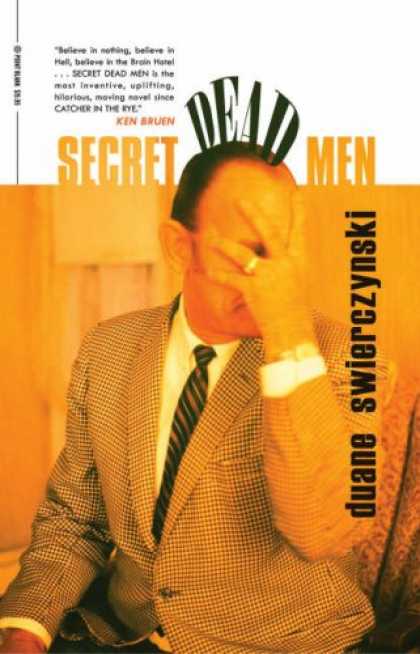
"Secret Dead Men" by Duane Swiercyznski


After reading "The Blonde", I was anxious to find something else by the author to check out. We have a copy of "Severance Package", his newest book, on order, but who wants to wait? So I found myself a copy of an older title, "Secret Dead Men". And after reading it, I'm just not really sure what to think.

This is not one of those logical action sort of books, where point A leads to point B leads to a neatly wrapped package of an ending at point C. I would most definitely call this a mind-f**k of a book. It's interesting in a "what the hell is going on here?" kind of way. And it's short, clocking in at just under 200 pages, so it's not as if it takes forever to reach the end.

Detective Del Farmer has an unusual ability to collect souls, often consulting with them after their deaths to help solve their murders. He's got an elaborate "Brain Hotel" in his mind where he compartmentalizes his souls, giving them the opportunity to have a bit of a life after their deaths. He even relies on them at times to take over his body to perform certain parts of the investigation. It's all been going fairly well until now. This last collection has become a complete fiasco, even though it may finally lead Del to the mysterious Association, the super-secret group he was investigating when he himself was killed. Yes, that's right - Del is actually a collected soul as well. After his collector, Robert, decided to "move on", Del was left in charge of the collecting - and the body that Robert was using. Del Farmer was incinerated in a car fire by The Association, thus his need for closure (and possibly revenge).

Del has gone to Woody Creek to investigate the death of one Brad Larsen, a professor in the Federal Witness Protection program. He "collects" Brad, who tells Del that he'll help him track down The Association (he has inside knowledge) if he will in turn help Brad get even with his killers. Brad's wife, Alison, was also at the remote cabin and now lies dead on the floor, something that is devastating to Brad when he finds out. Del agrees to the deal. But is Brad really who he says he is?

It's hard to say. There's Del, there's the characters "living" in Del's brain, there's the killers, there's a possible robot, and a whole lot more. As I said in the into, this is one weird book, but I liked it. It's a bit hard to follow at times, especially the leaps from "reality" to the internal world of the Brain Hotel. It does make sense in a strange kind of way, but you have to be willing to go along for the ride. Do NOT try to use logic on this book!

Thursday, May 22, 2008

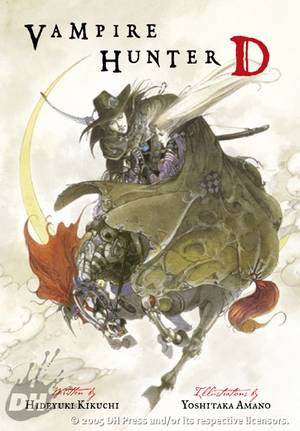
"Vampire Hunter D" by Hideyuki Kikuchi


This is the one that started it all, I guess. But having read this book, I cannot for the life of me understand why I loved the movie so much. Perhaps the film editors worked on the dialogue some, or jettisoned extraneous characters. In any case, if you ever watched that piece of anime from the 80's, keep that memory for yourself. The book isn't really what you're hoping for.

On the other hand, the book does give a bit of D's back story, if you couldn't piece it together for yourself. Moreover, it gives quite of bit of the history of the world in 12,090 A. D., something I don't remember the moving doing, which was helpful. Not enough to save the book, though.

The story is basically that a young girl of 17, Doris Lang, has been bitten by a vampire, the dreaded Count Magnus Lee. She's in search of a vampire hunter to kill the Lord; if that's done before the Count can completely turn her, she'll go back to being a normal human again. Doris and her younger brother Dan live on a farm on the outskirts of town; their parents, both Hunters, were killed a few years ago. Enter D, who accepts Doris's offer (although not completely). He becomes a bit of a big brother to Dan, making it all the more painful when he must move on at the end of the book. No, that is not a spoiler; there are at least 11 more volumes in this series, so you know D goes on to have more adventures.

There are a lot of characters to keep track of in this first installment, and I really didn't see all of them as necessary to the plot. Also, there is little to no character development, perhaps not all that surprising when one considers the manga origins of this translation. However, to say that a graphic novel is merely a flat comic is doing a grave disservice to such works as "Sandman", etc.

I myself will not be searching out any more of the Vampire Hunter D books. I prefer to remember the Vampire Hunter D of the movie; he was truly a work of art.

Tuesday, May 20, 2008

"The Big Squeeze" by Steven Greenhouse


If you've ever had an ogre for a boss, have ever felt completely unappreciated, or have ever been told "work smarter, not harder", then this book is for you. Especially if you're one of the myriad of American workers who are working for minimum or near-minimum wages. I saw some reviews of this book in a professional journal and really wanted to take a look at it. Now that I'm done with it, I have to say that it was probably one of the most depressing books I've ever made it through.

Mr. Greenhouse is definitely on the side of the little guy. In the first eight chapters he details such workplace violations as employees being forced to work off the clock, having their hours "erased" by supervisors, being locked in their businesses overnight, etc. Wal-Mart is, of course, one of the worst offenders and Mr. Greenhouse uses example after example to let the reader know just how bad this company has gotten. True, they have made a few efforts to fly the straight and narrow lately - but only after being dragged into court several times for said violations. Just in case you thought it was only the lowest of employees getting the shaft, the author also details how those trying to rise through the ranks must turn on their once-fellow employees, spying on them and being forced to find ways to either cut hours to make payroll or working off the clock themselves to get jobs done.

Thank goodness Chapter 9 is about companies that do things right; I wasn't sure I could take much more of the doom and gloom of the first chapters! Costco, Patagonia, Cooperative Home Care and the Culinary Workers Local 226 of Las Vegas are upheld as the sort of companies that can and do exist, ones that not only make profits but treat their employees well. And guess what? Those employees stay, saving the companies additional monies in hiring and training fees. It's something that those on Wall Street should really learn - happy workers are productive workers who work for a company long-term.

Perhaps the best thing that I read in this work was a maid who actually stood up to her boss. Ercilia Sandoval was working as a cleaner in Houston when the incident happened. Ercilia is an illegal, one of the many groups that can be exploited for cheap labor. The fact that she stood up to a tyrant boss who was mistreating another employee floored me; I don't know that I could've done it, fearing deportation and all. Here's a bit of the incident described in Ercilia's own words:
"One coworker from Honduras, she was cleaning floors, and the supervisor grabbed the bag with the worker's cleaning chemicals and threw them on the floor. She said, 'Pick them up.'
The woman started to cry, and I got involved. I asked, 'Why are you bothering her? If you're a supervisor, why don't they give you a talk on how to treat workers?' She said, 'Don't get involved. I'm not talking to you.'
I said, 'I know you're not talking to me, but just because you're a supervisor doesn't mean you should abuse people.'"
You go, Ercilia!

So what sort of solutions does Greenhouse offer up? Raising the minimum wage, or possibly enacting legislation guaranteeing workers a "living wage". Also, the author is pretty big on unions, which I'm not so certain I agree with. I think they can have their place, but I also think they've hurt workers in some areas by making demands that are unrealistic, as well as refusing to agree to any company requests when things aren't going well. The author is also probably pretty on-target when he laments the demise of pensions; there are a lot of people out there who either don't enroll in 401k programs or don't understand what to do once they're in them. But pensions aren't necessarily the answer either.

In the long run, the only thing that will elevate employees again and make it possible for the middle-class to thrive is respect. Employers need to respect their employees as human beings and treat them well, even if they can't pay them much. In turn, employees must respect their employer by giving 100% when they're on the job (honestly, you know that there are people out there taking advantage of their companies just as the companies take advantage of others!) I don't know if Americans will ever be as affluent as they once were. And reading this book certainly didn't help my convictions any. But it is important to talk about this issue, and I think Mr. Greenhouse has done a good job with it.