Friday, April 9, 2010

"90 Classic Books for People in a Hurry" by Henrik Lange


This little gem was turned in at our branch the other week. At first my co-worker and I thought it was a guide to "short" classics, works that were maybe no more than 100-200 pages long. But once we started paging through it, we realized that it wasn't a guide at all! Instead, this is a very, very funny look at the classics.

Lange has taken 90 titles and done 4-frame cartoons summing up each book. But wait - it gets better! The first frame of most every cartoon is the title of the book, so he's really telling you everything you need to know in a mere 3 frames. Brilliant! Works include "Ulysses", "A Confederacy of Dunces", "American Psycho", "The Lord of the Rings", and "Watchmen". Some work, some don't, much as any other collection. (We loved the one of The Bible).

This is definitely recommended by myself to all readers out there who have read a lot. I think this book works for me because, as an English major, I'm already familiar with many of the works depicted here, either having read them myself or just general knowledge. I can see where someone who isn't well-read might not enjoy the jokes here, but I think they could still appreciate it. Having said that... this is not a book that will help anyone looking for reviews or synopses of other works! I add this only because one customer review on Amazon showed that the reviewer completely missed the point of the book. I believe my blog readers are smarter and will get the jokes, but fair warning, right? Hope you laugh as much as I did!

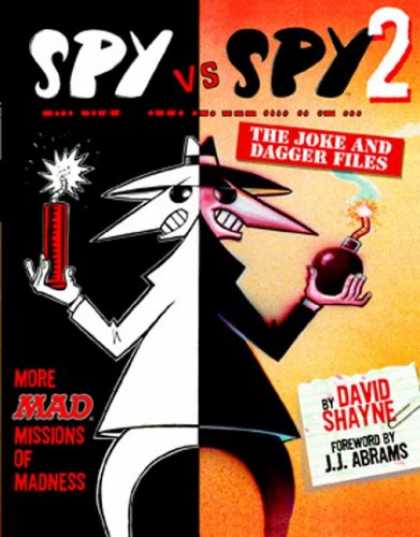
"Spy vs. Spy: The Joke and Dagger Files" by David Shayne


If you read the previous post, you know about my quest to get hubby something to read. This was the second of the "Spy vs. Spy" books that my library system acquired, this being a collection of some of the artists who took over the strip after Antonio Prohias retired. There are various artists represented here, including Bob Clarke and David Manak, with Duck Edwing providing the ideas for the gags they illustrated. And, of course, there are a multitude of the strips that were done by Peter Kuper, including the ones that came out in color (all the previous strips had been in black and white).

There's a foreword by Hollywood movie producer and director J.J. Abrams, plus some extras by Kuper himself. Not really much new as far as info goes.

The strips themselves are still typical "Spy vs. Spy" fare, with the Black Spy and the White Spy trying to kill each other at every turn. What I found interesting was the difference in each take on the spies; the strips by Clarke and Edwing have a bit more humor to them than the originals by Prohias, including most ending with the "victorious" spy giving the V-for-Victory finger wave. And for some reason, that V sign at the end of the strips made me think of Nixon - or maybe it was a comedian doing Nixon - mumbling out "I am not a crook". Go figure - the mind makes weird connections.

Then you get to the Kuper strips, and there's a very noticeable difference in style. There's the shift from black-and-white to color. There's also a bit more sinister tone to the plots. And when a spy is killed, it's much more grisly than anything seen before, with bits of brain and heart and teeth flying out to the corners of the panel. A bit shocking in b&w, even more so when he started doing the color. And I can't say I enjoyed them as much, either. Plus there's the "Grey Spy" - a rather buxom woman that I honestly don't remember seeing before.

The book concludes with the kids' version of "Spy vs. Spy", which is much tamer, of course. Rather than try to kill each other, the spies are sending each other to the Principal's office. I wasn't impressed, but if I was a kid, I might enjoy them. The Grey Spy makes appearances in these strips, too. And finally, there are panels from the commercials that were shot for Mountain Dew starring the Spies, which I sort of (but barely) remember. Overall, not a bad collection of work, but I have to say this - a little "Spy vs. Spy" goes a long way. And this book is on the long side.

"Spy vs. Spy: Missions of Madness" by Antonio Prohias

Searching for something for hubby dearest to read, I came across information in our library system that we had just cataloged two different books of the old MAD Magazine cartoon "Spy vs. Spy". I knew he'd talked about that 'toon before and how much he loved it, so I being the good library lady I am (and good wife!), reserved both books. This one came first, which worked out well; Antonio Prohias was the man who started it all. After Mr. Man was done with this one, I decided to pick it up since I haven't read anything from MAD in forever.

The cartoons are good, a bit somber at times, I now realize. But after reading the foreword by John Ficcarra, the style makes sense. I had no idea that the guy who originally did "SvS" was from Cuba, that he'd fled that country after getting death threats, or that there's a lot of cold-war subtext to the strips. Once I read that information, I really paid attention to the strips, and yes, there's a certain air of futility that comes across after a while. After all, one spy dies at the end of each 'toon - it was up to Prohias which one would bite the dust. And there was no way to predict which one it would be, just that one would be dead. Of course, he was always resurrected for the next strip.

The one thing I think is very funny is my take on the spies. For some reason when I was young, I thought they were crows, not men! I do believe I was confusing the spies with the magpies from "Heckle & Jeckle". Yeah, I was a weird kid!

"The Visual Food Lover's Guide" by QA International


What a completely awesome and cool little book! The subtitle states that this small work includes "essential information on how to buy, prepare and store over 1000 types of food". A truer statement would be hard to find!

The book is small-ish, which I found refreshing. Most works like this are large and bulky; this is not much larger than a regular hardbound book, and I could totally see myself using it in the kitchen with no problem. The sections are nicely laid out and follow a logical pattern, dividing such basic categories like fruits and vegetables into smaller, more specific categories, such as tropical fruits and root vegetables. There are color pictures of each and every item, as well as the basic facts about each entry: what it is, what to look for when purchasing it, how to store it (and how long it will keep), and different suggestions for cooking/preparing it. There's even a small insert of nutrition facts on most items, too.

If you cook often, this may not be an essential item to have (but it would probably be nice - after all, sometimes you run into a recipe with an "odd" ingredient or two). If you're new to cooking or want to learn more and expand your repertoire, this would be a perfect reference guide for you. Even better? It retails for a mere $16.95, and when I looked around, it appeared that most etailers had a discount on it. Or..... you could always check your local library!

Friday, March 26, 2010

"What Was Lost" by Catherine O'Flynn


Every once in a while there's a "happy accident" here at the checkout counter, something that comes across the desk either as a return or as a reserve, something that catches my eye and intrigues me. This is exactly one of those titles; if memory serves correctly, it was in our outside book drop one morning, and after reading the description on the back, I wanted to read it. I just didn't have time right then, so I placed a reserve on my card for around the time I was going to have a week off. Of course, I didn't actually read it on that vacation - too many other books to get thru!

The book opens in 1984 as we follow 10-year-old Kate Meaney as she learns how to follow people, write down observations, and locate clues using the book How to Be a Detective, a gift from her father. She's started Falcon Investigations and her partner is her stuffed monkey, Mickey. Their main beat is the newly opened Green Oaks shopping mall, a huge complex of stores, a place that inspires love and loathing amongst the locals. Kate doesn't have any friends as such, although she does eventually talk to a girl in her class, Teresa Stanton; Kate's work as a detective allows her to see what the others in her class seem to miss. It's a fairly lonely life, although Kate does spend time with Adrian, a 22-year-old man working at his father's sweets shop. Adrian knows all about Kate's undercover work, and even suggested his father hire her when the shop was losing sweets to shoplifting school kids (the young entrepreneur did a thorough investigation and made a few suggestions as to placement of goods, resulting in a "Good girl!" reward). Then, the unthinkable happens - Kate vanishes, never to be seen again. The police investigate, focusing on Adrian, who also disappears.

Fast forward to Green Oaks circa 2003. Adrian's sister, Lisa, works as a assistant manager at Your Music in the Green Oaks mall. She hates her job, hates the people she works with, and hates Green Oaks, but she's being groomed to manager her own store, dates and lives with one of her co-workers, and spends almost all her waking hours at Green Oaks, either working or shopping. One evening she finds herself working later than usual and becomes lost in the maze of corridors and tunnels that run behind the shops. One of the security guards, Kurt, runs across her in his patrol and guides her to the door to the parking lot. While on their way out, Lisa stumbles across a stuffed monkey, one that looks suspiciously like the one Kurt saw a little girl holding on the security monitor after closing time, a little girl who vanished when he looked away from the TV screen. Lisa and Kurt form a bond over their misery of life at Green Oaks, their fascination with the mysterious child, and their hopes of a better life.

It doesn't sound like much, but trust me, it's worth it. There are connections between characters that at first I found overly convenient, but then I couldn't stop thinking about them and how the author had accomplished this feat - it works. The background stories of Lisa and Kurt rang true, two people who had hopes and dreams as children and teenagers, only to become trapped in the reality of adult life, caring for parents and paying mortgages, etc. The title obviously refers to Kate and Adrian, who are literally "lost", but it could also to refer to all the other "lost" things in the book - lost dreams, lost hope, lost opportunities, lost illusions. The ending was sad yet brilliant. What I found interesting was the number of reviewers on Amazon who didn't believe Kate was really a child; they thought she sounded "too adult" and no different than the other characters. I thought Kate was a dead-on description of a very mature child, one that prefers to spend time in her own company doing her own thing, rather than try to fit in with the other kids. She prefers talking to older people rather than her peers, and I totally understood that, being much the same myself as a child.

This is a debut novel by O'Flynn, and I'm happy to report that she has another book out this summer. "The News Where You Are" will be released July 6th and I've already got it on my wish list. I have high hopes for this author and look forward to her next book!

Tuesday, March 23, 2010

"This Book is Overdue! How Librarians and Cybrarians Can Save Us All" by Marilyn Johnson


Marilyn Johnson wrote a book called "The Dead Beat" about obituaries. Nothing extraordinary about that - except that she dealt with librarians enough that she fell in love with them. And decided to write about them.

The book isn't really a story per se, more little vignettes of Johnson and her dealings with librarians in different settings. The one thing they all have in common is a love of knowledge and a desire to catalog it somehow. After all, as Johnson points out, there is so much data available that we suffer from a sort of "information sickness"; librarians can help make sense of it all (and they know were to find the correct information, the factual data, as opposed to just doing a Google search).

One of the ways that libraries and their employees help sort and store all this data is through technology, specifically computers. Johnson discusses the two factions in the library world, those that embrace all new technological advances, and those that don't even want to touch the things. She follows a library going through an "upgrade" in their operating system, and the frustration felt by both library staff and the tech support team trying to help them. She looks at some of the blogs now being written by library employees, some serious, some not and how this new form of communication is helping other library employees get new ideas (and sometimes laugh at the things they have to deal with working with the public). She details the case that went to court recently in which a small group of librarians took on the government, fighting to keep their patrons' records private, and the toll it took on all involved (a very scary chapter - the Patriot Act is thrown around with the weight of "this is right, and if you defy us, you're against all that is American).

I loved the chapter on the group known as Radical Reference, library employees who take to the street during political conventions and such, letting people know what streets are closed, where public bathrooms are available - and where the cops are cracking down on protesters. They have their cell phones and Internet access, and they're not afraid to use them! Also interesting were the library employees who have avatars in Second Life, setting up virtual libraries and disseminating information to all who need it. Certainly helps break down the stereotype of the quiet, sweater and crepe-soled shoe wearing, shushing librarian!

Sadly, not everything is stable and good in the world of libraries. Just as the New York Public Library debuts wonderful online resources for their patrons, they close down reference rooms that store vast amounts of arcane knowledge. And in the chapter "What's Worth Saving?", Johnson laments that not everything is considered "essential" when deciding what should be cataloged and kept. I understand where she's coming from, but as someone who works in a small branch, I can say without remorse that you just cannot keep everything. Space is a premium for us, and we routinely weed items that are no longer circulating. Fear not - if they're still in good shape, they go to our annual Book Sale run by our Friends of the Library, and those proceeds help us in so many ways.

While I enjoyed this book (especially the small section about poop and "rogue turds"!), I often felt left behind. Yes, I am all about libraries, but no, I am not one of those library professionals who has completely embraced all this electronic. I still don't own a cell phone. I don't text. I don't Tweet (mostly because I can't keep it short, as you know if you're a regular fan of this blog!). I don't spend much time on a computer, and don't even own one of my own (another good argument for public Internet access). And as someone on the front lines, I can honestly say that there a lot of people who don't have all this technology either. My branch is in a poorer community, one with great unemployment, including older people who not only don't own PCs, they've no idea what email is or how to set up an account. These are truly the people we serve, and as such, we rely on our "hardware" more than our software. Luckily, there's a place for this, too, as Johnson quotes near the end of her book. I'll close out this review with her quote, which I think pretty much says it all.

"We'll always need printed books that don't mutate the way digital books do; we'll always need places to display books, auditoriums for book talks, circles for story time; we'll always need brick-and-mortar libraries."

"Just Another Judgement Day" by Simon R. Green


Book 9 in Green's Nightside series opens with our usual scene in the dark spot of London, that place where it's always 3 a.m. and the streets are full of strange and fearful things. John Taylor, the man who can find anything, son of Lilith, has been summoned to meet the New Authorities; they are already in need of his services. And the New Authorities are a group that John is all too familiar with...

Julien Advent, the legendary Victorian Adventurer, is now the editor of the "Night Times". He's also leading the New Authorities as such. Jessica Sorrow, the Unbeliever, is part of the new group, although her fellow Authorities are uncertain as to how stable she truly is. Annie Abattoir is the only other woman in the group, a spy, assassin and courtesan. Count Video, lord of binary magics, King of Skin, ruler over the world of porn and sleaze, and Larry Oblivion, the dead detective, round out the rest of the seats. John is uneasy around the New Authorities; he's seen the same group in a future time-line, a future in which these same people were the last survivors of humanity - and his enemies. The group had sent back a future Suzie Shotgun to kill John and prevent the awful reality that they inhabited.

The New Authorities want John to stop the Walking Man, a personal embodiment of the Will of God. He was merely human until he made a deal with God to become more than a man, wiping out "evil" in God's name. He cannot be killed "as long as his faith remains true and he walks in Heaven's path". He has guns that never run out of bullets (and never miss), he can open any door, he can find any evil, etc. Truly unstoppable - and truly frightening to those living in the Nightside. John will be aided in his quest by his girlfriend, Suzie Shotgun (aka Suzie Shooter) and Chandra Singh, a holy warrior from India who has killed his fair share of monsters.


This was a very good entry in the world of John Taylor and the Nightside, very philosophical if you will. Oh sure, there's still a lot of weirdness going on and all the favorites make an appearance, including Eddie, Punk God of the Straight Razor (and he appears on the Street of Gods, no less). The deep stuff comes when the characters start discussing God, whose God is the "right" God, the stronger deity, etc. And the whole idea that the Walking Man has God on his side - does he really? Or is he just killing in His name? My favorite quote comes from Chandra during one of these scenes; he tells John "In my travels, I have met many who claimed to hear the Voice of God instructing them to do things, and most of them had to take a lot of medication. Few of them were in any way worthy of the God they claimed to worship".


Visit the Nightside soon, if you haven't already. They're waiting for you...