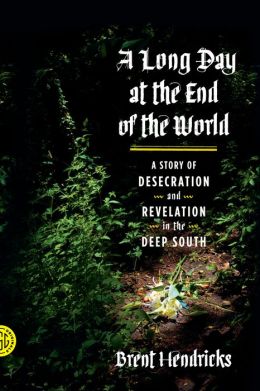
In February 2002, hundreds of decayed, abandoned bodies were discovered at the Tri-State Crematory in rural Georgia. It was the largest mass desecration in modern American history. The perpetrator - a well-respected family man and former hometown football star - had managed to conceal the horror for five years.
Among the bodies was that of Brent Hendricks's father. To address the psychic turmoil caused by this discovery, Hendricks embarks on a pilgrimage across the disturbed landscape of the Deep South to the crematory site. In [this book], he reveals the gruesome and bizarre details of the desecration and confronts his fraught relationship with his father - wrestling with the grief surrounding his death as well as the uncanniness of his startling resurrection.
This is one of those little finds across the library desk. A patron returned the book and of course wanted to tell me about it. I thought it sounded like the sort of thing my husband would be interested in (he reads mysteries, true-crime, forensic stuff), so I checked it out and took it home. He read it in no time flat (maybe 48 hours?) and kept telling me about little things here and there. Since it's such a small book, I decided to pick it up myself.
It's interesting, I'll give him (and my patron) that. My biggest problem was that I wanted to know a lot more about Brent Marsh, the man responsible for the 339 bodies that were found on the crematory grounds, left in all sorts of disarray and states of decay. But since Hendricks wrote the book about his journey to see his father's last "resting" place, the story of Marsh is doled out rather sparingly. Granted, Hendricks makes it clear that there's not a lot to know about Marsh; he never gave a reason for his failure to perform his duties. He didn't do it to make money, as the savings per body was rather paltry. Theories run the gamut from laziness to a sort of overworked-snowball-type thing, where he got behind on his crematory duties and started to dump a body here, a body there, perhaps planning to catch up later, but of course, never able to get the upper hand on the situation. And much like an office worker who gets behind on paperwork, then starts hiding it to hide the fact that he/she is behind, the theory goes that Marsh dumped more and more bodies.
I'd be very interested in reading more about one theory Hendricks talks about, that of hoarding. One psychologist proposed that Marsh was, in essence, exhibiting hoarding tendencies with his acres of bodies. And while it sounds plausible, one has to wonder why he would only hoard a portion of the bodies he received for cremation; he still performed over 600 some cremations during the 5 years or so that this was going on. Why keep some but not others? And if one is hoarding bodies, why? The only people I've ever read about keeping bodies as such have all been serial murderers. These people were already dead when Marsh received them.
Perhaps the best theory is that Brent Marsh had to go into the family business, but it was about the last thing he wanted to do. He simply did not want the job. And maybe that's why he did what he did - he just hated his job. We'll never know, and the reader definitely doesn't learn much more from this book. Hendricks talks mostly about his journey across the South, about his childhood, about the reason his father came to "rest" at Tri-State, and how biblical it all is to him, the son. His father was displaced from his original home by a flood (one to create a lake and dam), and after he died, he was buried in the ground. Hendricks's mother, however, had a growing phobia regarding burial, and after some years, had her husband exhumed so that she could have him cremated. I know - how ironic that he should end up at Tri-State, suffering a fate, one would imagine, much worse than mere burial.
As I said, it's an interesting subject. And while I would recommend the book merely for that reason, be prepared - the author gets extremely philosophical, and tends to repeat himself. It does make me wonder if anyone wrote anything on just the Tri-State Crematory desecration itself. Time to do some digging, if you'll pardon the pun!
Tuesday, September 24, 2013
Monday, September 23, 2013
The Potty Mouth at the Table by Laurie Notaro
Pinterest. Foodies. Anne Frank's underwear. New York Times bestselling author Laurie Notaro - rightfully hailed as "the funniest writer in the solar system" (The Miami Herald) - spares nothing and no one, least of all herself, in this uproarious new collection of essays on rudeness. With the sardonic, self-deprecating wit that makes us all feel a little better about ourselves for identifying with her, Laurie explores her recent misadventures and explains why it's not her who is nuts, it's them (and okay, sometimes it's her too).
Whether confessing that her obsession with buying fabric has reached junior hoarder status or mistaking a friend's heinous tattoo as temporary, Laurie puts her unique spin - sometimes bizarre, always entertaining - on the many perils of modern living in a mannerless society. From shuddering at the graphic Harry Potter erotica conjured up as a writer's group to lamenting the sudden ubiquity of quinoa ("It looks like larvae no matter how you cook it"), [this book] is whip-smart, unpredictable, and hilarious. In other words, irresistibly Laurie.
I've been a fan of Notaro's for some time now, so when I noticed that our library system had picked up her latest work, I rejoiced. Then I got it home, and really rejoiced - this book is funny. I usually relate to most of what she's saying, but this one had me laughing out loud, a very good thing.
From getting dissed by the Antiques Roadshow people to her horrific encounter with the world's worst-smelling cab, this book is just awesome.Her piece on why she hates the yoga people had me practically in tears (how many dead bodies can one author find?), as well as why she's over foodies, the things she's sick-to-death-of on Pinterest, and the six things she never wants to hear in the pharmacy line again (I'm very much with her on those). I really enjoyed her chapter "Fabric Obsession"; I don't have one that causes me to buy any, but I can't walk into a fabric store and not touch just about everything that's displayed. Especially if it has some sort of texture to it. It's weird, I know. And sadly, not always limited to fabric stores.
The book really does run the gamut from the hysterical to the touching. The titular chapter is a witty piece about her literary duel with a "serious" author, as well as trying to stomach sessions such as those devoted to erotic fan fiction. (totally with her on this one - I do NOT want to read about any of my fave fictional characters doing the nasty - not unless those scenes are written by the author him/herself. Eww...) The final chapter, "Rewinding", takes a serious turn as Laurie and her circle confront one of life's hardest lessons - the potentially fatal illness of a friend. It's a very moving look at how this wise-cracking writer helps a friend who is diagnosed with a brain tumor, how she copes with her fears while being strong for her friend. And how life changes, but not always in a bad way. I was very surprised to see this chapter, but I think it also shows her growth as an author.
Highly recommended.
Monday, September 16, 2013
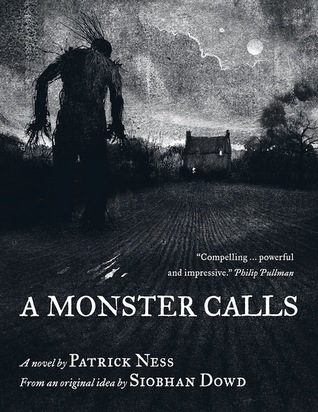
A Monster Calls by Patrick Ness (inspired by an idea from Siobhan Dowd)
This is one of the titles that was selected for the local middle school system's Battle of the Books. I've wanted to pick it up for a while, as the cover is very intriguing, and it says something about being a horror novel. That surprised me, as I usually think of the list of books as being serious writing; horror doesn't strike me as being the sort of genre that would be chosen.
After reading the book, I see how wrong I was. It's a powerful book, disguised as a young boy being haunted/terrorized by a mythical creature. Conor O'Malley has nightmares, horrible nightmares. When a monster shows up one night at seven minutes past midnight, Conor isn't surprised. He's also not scared; he explains to the monster (a sort of enormous evil tree-man) that he's seen worse. And he has...
Conor's mom has cancer. She's undergoing treatment yet again, as the previous rounds of chemo don't seem to have worked. His maternal grandmother is a cold fish, someone who doesn't understand the young boy and doesn't seem to want to. His father lives in America with his new family (I'm doing this a couple months after I read the book, so bear with me - I think Conor lives in the U.K.) He really doesn't have any friends at school, so there's no one for him to turn to, no one to talk with, about his mom's illness. No one except the monster who shows up just after midnight.
It is mature subject matter, which has some questioning if kids/teens should read it. Having lost my own mother recently to cancer, I think if the reader has gone through the same thing, then yes, they should read it. It's powerful, this idea of what is true and what is not, that things are not always as they appear to be, and that the best lies we tell are the ones we tell ourselves.
And I would recommend having a box of tissues handy.
Saturday, August 10, 2013
The Deceased by Tom Piccirilli
Something is calling Jacob Maelstrom back to the isolated home of his childhood - to the scene of a living nightmare that almost cost him his life. Ten years ago his sister slaughtered their brother and parents, locked Jacob in a closet...then committed a hideous suicide. Now, as the anniversary of that dark night approaches, Jacob is drawn back to a house where the line between the living and the dead is constantly shifting.
But there's more than awful memories waiting for Jacob at the Maelstrom mansion. There are depraved secrets, evil legacies, and family ghosts that are all too real. There's the long-dead writer, whose mad fantasies continue to shape reality. And in the woods there are nameless creatures who patiently await the return of their creator.
I'm dumbfounded. Truly. This is the same author that wrote Every Shallow Cut? Really? I'm pretty sure someone is pulling my leg. Can't be the same guy. This book is such a mish-mash of...well, I'm not really sure what it is. Except nothing I enjoyed, that's for sure.
Yes, I finished it. I have no earthly idea why I kept reading, unless I thought at some point that it would make sense. In a way, the book is very much like a nightmare: you're not entirely sure what's happening at any given moment, and even when it's over, you find yourself asking what the hell just happened. I suppose in that sense the book works. Still, very frustrating to read some 300 pages and have no more idea of the plot than when you started.
None of the characters are particularly sympathetic, either. Sorry, just couldn't root for anyone, the real ones or the imaginary characters (at least, I think they were imaginary - again, no real direction on that). If they had all died in the end, I might have actually jumped for joy.
Hopefully the next book of Piccirilli's I pick up will be better. I'd hate to think Every Shallow Cut was his only good one.
Saturday, July 20, 2013
Shadow's Claim by Kresley Cole
Trehan Daciano, known as the Prince of Shadows, has spent his life serving his people - striking in the night, quietly executing any threat to their realm. The coldly disciplined swordsman has never desired anything for himself - until he beholds Bettina, the sheltered ward of two of the Lore's most fearsome villains.
Desperate to earn her guardians' approval after a life-shattering mistake, young Bettina has no choice but to marry whichever suitor prevails - even though she's lost her heart to another. Yet one lethal competitor, a mysterious cloaked swordsman, invades her dreams, tempting her with forbidden pleasure.
Even if Trehan can survive the punishing contests to claim her as his wife, the true battle for Bettina's heart is yet to come. And unleashing a millennium's worth of savage need will either frighten his Bride away - or stroke Bettina's own desires to a fever pitch...
I've been a fan of Kresley Cole's Immortals After Dark series pretty much since it started. I figured picking up this title, the first in her Dacians series, would be a safe bet. While the plot itself is OK, I wasn't enjoying this nearly as much as I had expected, which leads me to question if 1) the writing wasn't up to par or 2) I've just grown tired of paranormal. Maybe it was a bit of both?
I read the reviews on Amazon, and most absolutely loved this book - specifically the "hot" sex scenes. I think it was probably my biggest problem with the book. Look, I get that sex sells, and I get that Cole writes hot scenes between Loreans, etc, but for the love of all that's holy, do we really have to have so many? About half to 2/3 of the way thru the book, I felt like I was reading about Bettina and Trehan and their sexual exploits every other chapter. I literally started skipping to the next scene where they were NOT having sex, just so I could get on with the storyline. Sorry, but I do believe you can overload on too many scenes of "throbbing" manhoods, plus I'm starting to loathe words like "hot", "moist", and "wet". Sigh.
The story itself really isn't much different than any other IAD book from Cole: Immortal meets fated Mate, they dance around the fact that they are fated mates, someone's life is thrown into jeopardy, sex, sex, and more sex, then we get a happy ending, sometimes both literally and figuratively. And this time, I really noticed how primitive some of the relationship is; there were scenes where Trehan is "roaring" about Bettina being his Bride, and I kept flashing to "Me Tarzan, you Jane". Good grief, do readers really like that sort of he-man stuff?
I found myself much more intrigued by Bettina's guardians, Raum and Morgana. There's obviously a backstory there, given the love-hate relationship the two seem to have (and no, they're not a couple, at least not in this book). I wanted to know a lot more about Salem, the disembodied sylph/phantom that watches over Bettina at Morgana's behest; he was fascinating, and much more interesting than our main characters.
Then there's the tournament itself. I had a very hard time with it, the very brutal set-up that all competitors fought matches to the death for Bettina's hand in marriage. Talk about barbaric! Yes, I get that this isn't the modern world, that we're talking about demons and such here, but still - very squirm-inducing, not to mention a huge throwback to the olden days of girls being chattel for their fathers. And not everyone in the tournament is a "bad" guy; there's one scene in particular that has a complete innocent dispatched, and I just about stopped reading right then. Personally, I found it very upsetting, and unnecessary to forward the plot.
Finally, there's Bettina herself. Sorry girl, you are annoying. Pining constantly over her childhood friend, Caspion, wanting him to notice her as a woman, blah blah blah. Being so terribly afraid after her attack, being afraid to go anywhere, do anything, stand up to anyone, etc. Look, I get that her attack was a traumatic event for her, and I do understand that sometimes people have a very difficult time getting past something like it. But she whined so much about everything - hard to get behind a heroine who you just want to slap.
Can't say I would personally recommend this, but if you like this sort of thing, feel free to check it out.
Wednesday, June 12, 2013
The Hidden Life of Wolves by Jim and Jamie Dutcher
In [this book], wildlife filmmakers Jim and Jamie Dutcher present an untold story as intriguing and unique as the animal it profiles, sharing a panorama of human attitudes about wolves, from myths of ancient times to misconceptions of today to the new understanding they advocate. With their extraordinary photography of the Sawtooth Pack, personal observations, and thoughtful analysis, they present an engaging story of their experiences living among wolves.
Detailing the emotional and social lives of the Sawtooth Pack, the Dutchers recount wolf behavior rarely documented: grief at the death of a pack mate; exuberant play and friendships; excitement over the birth of pups; and the shared role of raising young pack members, teaching them needed skills.
In the larger picture, they describe the reintroduction of wolves into Yellowstone National Park and the cascade of positive results that followed. The return of wolves has helped revitalize the park's ecosystem, influencing elk, birds of prey, pronghorn, aspen trees, and even trout.
But the demonization of wolves continues as they struggle to reestablish their foothold in the American West. Ranchers, hunters, and biologists work to adapt to innovative solutions that encourage coexistence and reduce conflict. Providing vital information that can change misguided perceptions, The Hidden Life of Wolves opens a fascinating window into the unseen lives of wolves by two people who lived in their midst.
There's really nothing I can say about this book except FIND YOURSELF A COPY. Seriously. I've been recommending it to pretty much everyone I know. It's gorgeous, and full of very interesting/important information. The text isn't all "wolves are awesome!", which tells me the authors really did do as much research as they claim to have done. The facts are presented well, the good with the bad, the challenges, the disappointments. And if you already have a soft spot for wolves, then you'll want to not only find a copy to read, but most likely want to buy a copy to keep. I know I'm toying with that idea myself; if nothing else, I'm hoping to get a copy for my library branch (we only have one in our library system at this time).
There's a plethora of amazing pictures, and quotes from several different sources help illustrate the authors' point about the necessity of wolves to the environment. My favorite was this quote by Aldo Leopold, from A Sand County Almanac:
"We reached the old wolf in time to watch a fierce green fire dying in her eyes. I realized then and have known ever since that there was something new to me in those eyes - something known only to her and to the mountain. I was young then, and full of trigger-itch; I thought that because fewer wolves meant more deer, that no wolves would mean a hunters' paradise. But after seeing the green fire die, I sensed that neither the wolf nor the mountain agreed with such a view."
Highest regards for the authors, their book, and anyone who seeks it out.
Tuesday, June 4, 2013
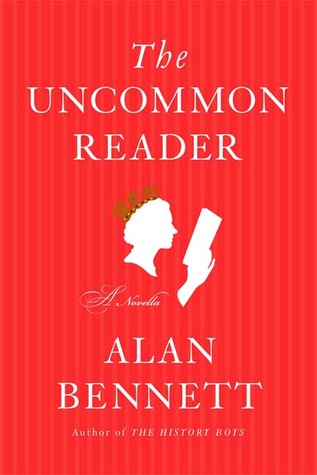
The Uncommon Reader by Alan Bennett
When her corgis stray into a mobile library parked near Buckingham Palace, the Queen feels duty-bound to borrow a book. Discovering the joy of reading widely (from J. R. Ackerley, Jean Genet, and Ivy Compton-Burnett to the classics) and intelligently, she finds that her view of the world changes dramatically. Abetted in her newfound obsession by Norman, a young man from the royal kitchens, the Queen comes to question the prescribed order of the world and loses patience with the routines of her role as monarch. Her new passion for reading initially alarms the palace staff, and soon leads to surprising and very funny consequences for the country at large.
I can't tell you how many times I've looked at this little book and thought "I should read this". It's a novella, so it's a nice length when looking for something that won't take a month or more to slog through. I like the British, and I'm fond of the royal family, so that was another plus in it's favor. And what's not to like about someone discovering the love of reading? Sadly, this title has shown up more than one in my pile of "should I weed this book or not?" pile. I'm very thankful that I never pulled it from our inventory in my little branch, and now that I've read it, I'm going to be recommending it quite often to patrons.
It's an interesting idea, the Queen borrowing books from the public library, and a "mobile library" to boot (what we call a bookmobile here in the States). I love that it was someone from her own kitchens that really introduces her to some great authors, proving that books are a great equalizer. If you can read, the whole world is at your fingertips, and a public library means that money is no obstacle to that world.
What I thought was interesting, and even kind of sad, was that the Queen always refers to herself as "one" - as in "one must not have opinions about what one is reading" or "one must, one supposes, take out a book". What must it be to go through life not thinking of yourself as "I" or "me" or even "insert-your-given-name-here". But as the Queen reads, you see a bit of that attitude changing, which is very interesting.
Some of this is humorous, although I'm not sure I'd call it laugh-out-loud funny. The staff trying to hide her books was good for a chuckle, as was the Queen becoming quite irked at having to go out to some function or other when all she really wanted to do was stay in and read. I get that, and I'm sure all you bibliophiles do, too. Perhaps the most interesting comment was a thought the Queen has after meeting several authors at a party she's put together. Even though she has enjoyed their books, she becomes quite tongue-tied and finds she can't really think of anything to say to these people who have opened up her world. Of course, not every author is nice or what she expects them to be like, resulting in this thought: "Authors, she soon decided, were probably best met within the pages of their novels, and as much creatures of the reader's imagination as the characters in their books."
A wonderful find, and one that is highly recommended by yours truly.
Subscribe to:
Posts (Atom)