Monday, April 30, 2007

"Happiness Sold Separately" by Lolly Winston


Elinor and Ted Mackey are in crisis mode. Not only are they not able to get pregnant, Ted has turned to another woman. He is having an affair with his fitness instructor, Gina Ellison. Elinor has just found out about the affair as the book opens, and the novel follows them as they try to mend their marriage.

Elinor retreats to her mother's for a while to think things through. Ted tries to stay away from Gina, but finds it difficult. Making matter worse are Gina's son, Toby, who has returned to live with his mother after his new stepmother decides she doesn't want him underfoot. Toby takes an immediate liking to Ted, who agrees to tutor him in math. Ted comes to enjoy spending his tutoring evenings with Toby and Gina, who makes them a home-cooked meal after each session. Now Ted is not only cheating on Elinor with Gina, but also with a ten-year-old boy.

Elinor decides to take up with the tree surgeon who shows up one morning to tell her her oak tree is diseased and will be removed by the city. She thinks of him like a tree - he is tall and strong. She also realizes that Roger, the boy she's hired to clean her house, has a huge crush on her. She offers to look at his portfolio for him; he's really a photographer but hasn't completed his final project and doesn't want to take some stupid job clicking pictures of school kids. Roger leaves behind strange objects in the beds of the people he cleans for, mostly to try to jolt them out of their boring lives.

The novel takes some unusual twists and turns as each character comes to be involved in the others' lives. Everything is intertwined by the end of the book, and the resolution isn't wrapped up in a nice little neat package.

While I loved "Good Grief", Winston's first novel, I can only muster mild enthusiasm for "Happiness Sold Separately". I'm not sure why, but I think I have a few reasons for it, the first being that there are way too many flawed characters for one book. Don't get me wrong, I think it's good for characters to have a few flaws here and there. Face it, folks, Prince Charming does NOT exist. But these people - they made me soooooooooo tired! I kept thinking "These are adults? These are grown-ups? They ALL are this messed up?" The only "normal" person in the bunch is Elinor's neighbor and best friend, Kat, and believe me, I found myself wanting her to have much more page time. Pretty much every character on the canvas needed some serious therapy time.

The other reasons probably have to do more with the subject matter, which is mostly infidelity and children. I can't really relate on either count. I know it can be difficult for some women when they desperately want children and can't have them. Knowing that doesn't make it easier for me to be sympathetic, though, as I personally have never wanted children nor have I wanted to be a mother. That makes it hard to relate to Elinor, who wants the child she can't have, and Gina, who has a child that doesn't want her. I've not gone through the pain of infidelity, nor do I worry about it, so relating to that plot line was also difficult. I just found myself feeling ambivalent about these people and their problems, which made me sad. I really wanted to like them, but they just weren't likable!

I'll wait and see what Ms. Winston puts out next. If it looks more like her first book, I'll gladly pick it up. If, however, it looks to be more of this line of writing, I'll pass. Sorry, but why waste time reading about people that you don't like, and that in the end, depress you?

Tuesday, April 24, 2007

"The Time of Feasting" by Mick Farren


This is one of those books that I probably could have and would have put down if I was a bit busier. The plot is pretty basic, the characters weren't too bad, the action was humdrum - until the last 100 pages. Then the thing took off like a flash. Just wish Farren had put a little more effort into the other 2/3 of the book.

Renquist is a vampire well over 1000 years old. He is the Master of the New York colony of vampires, a group of bloodsuckers basically living on the down-low. They really don't do much; no one has a job, no one really goes out much, they don't draw attention to themselves. It's best this way; there was a slaughter of vampires in 1919 and they've tried to hide themselves ever since.

Now there's a new generation of Nosferatu, and they want to go out and play. Especially now, during the Feasting, a sort of crazed blood lust that rolls around every seven years. Normally, these times of gluttony are handled by the colony going "on vacation" to far away lands where such things won't be noticed, foreign countries in political turmoil or besieged by plague. Renquist has decided that this time will be different. The colony will stay in New York and the members have been ordered to make their kills look like the work of a serial killer. One of these young vampires, Carfax, is determined to go all out, as he is tired of hiding in the Residence. He feels that as a vampire, his heritage allows him to do whatever he wants whenever he wants, that he is superior to humans. Needless to say, this sort of teen-aged tantrum is going to cause problems.

Also threatening the Colony is Kelly, an alcoholic defrocked priest, who sees Renquist and immediately knows what he is. Once he decides that this is his chance to make right with God, Kelly dogs Renquist and makes it his mission to kill the vampires. He enlists the aid of two NYC detectives, neither of whom is mentally ready for the idea of the undead roaming their city streets.

As I said, the first 2/3 of the book is just OK. There's a lot of exposition about the nature of the vampires, how the colony is set up, the relationships within the colony, etc. There's also some stuff about how the vamps were originally created by aliens, which sort of made sense, and sort of didn't. It seemed a bit "out there", even for a vampire novel! And again, the character development is all over the place. Renquist and a few of the other vampires are fairly well-rounded, while other characters are rather one-note. Carfax certainly falls into this latter category, which is too bad. Imagine how much better this might have been had he not come across as a petulant child, if he'd had more reason for his actions other than "I want to!" The action in the last hundred pages was good, enough to keep me reading to the end, as the story finally got exciting.

This is the first in a series by Farren. I'm not sure I'll read any of the other entries, though.

Saturday, April 21, 2007

A trip to the vault

Let's take a little trip into the vault and look at two books the Bookbabe found extremely captivating. Even better, these books are actually complimentary of each other in an odd sort of way.

First up is "Perfume" by Patrick Suskind. This little gem has been around for a while and the Bookbabe first learned about it when she worked at the used book store long ago. A customer had recommended Suskind, saying it was rare to find his works, the author being German and not very well-known here in the United States, etc. He went on to tell me that of the works that had been translated, I would be wise to keep my eyes open for "Perfume", by far Suskind's best. It took a while to track it down (over a year, if I recall), but it was worth it.

The story goes like this: a child is born with a unique sense of smell, a sort of human bloodhound. However, this same child, Jean-Baptiste Grenouille, has no odor of his own, a condition that seems to turn the human race against him. His mother is disgusted by him and his wet nurse finds her job incredibly difficult, as she claims that he does not smell right - he has no "baby" smell. He is brought up as a thing rather than a human. Grenouille survives his childhood and apprentices himself to a perfumer, learning everything there is to know about the art of creating perfume. While his skill brings great fame and fortune to his mentor, Grenouille has bigger plans. Plans that will involve murder.

More than anything, Grenouille wants to be loved and adored, and he knows this is impossible due to his lack of odor. His plan is to "distill" the most pleasing of human odors and create a unique perfume, one that will draw in every human within a hundred-yard radius. The only drawback to the plan is that it will require the deaths of several people, as that is the only way to "distill" the essence he is searching for. Grenouille is certainly not above killing; his childhood has not instilled a conscience in him.

"Perfume" has a slow, subtle increase of dread and horror, much the way a good scent wiggles its way into your brain. It's not necessarily what I would call action-packed, so if you prefer that sort of thriller, this might not be to your liking. But it's a book that I often recommend and that I've never forgotten.

The second book is a non-fiction work about scent and how it is registered in the body. I know, sounds boring, doesn't it? But in Chandler Burr's "The Emperor of Scent", the entire process is thoroughly examined and turned on its head by one Luca Turin. Turin is a scientist who is proposing a theory on how our sense of smell works, one that is at odds with everything that has previously been written. The saga of his attempts to publish said theory are funny and frustrating at the same time; his peers want nothing to do with him and his "outrageous" ideas. Turin then goes to the perfume industry with his findings in hopes that they will listen to him, since he will be sharing something that should make them quite a bit of money. That industry turns out to be just plain confusing, both for Turin and for us.

The strength is this book is not only Burr's writing but also in the character of Turin himself. This is no stodgy scientist - think more absent-minded professor with the enthusiasm of a child. Turin is fascinating and I kept thinking how much I'd love to meet him, even if I wasn't sure I'd understand a word he said! And this work, as I said earlier, makes a great companion piece to the fictional "Perfume".

Just a little suggestion from the vault, dear reader.

Friday, April 20, 2007

"Heart-Shaped Box" by Joe Hill


I was anxious to read this book as soon as the reviews started popping up; critics were giving it some fairly high praise, and the story just sounded pretty good. Then the real kicker - turns out that Joe Hill is really Joe King, as in Stephen King. Yep, this is the King of Horror's kid. Well, that put a new spin on things. Did I still want to read it? Would I find myself constantly comparing it to his dad's works? Would I be disappointed?

Rest easy, readers. The answers were yes, sometimes, and no. The influence of his famous father is there, but it in no way overshadows or detracts from the story. Joe is a great writer, one that his dad I'm sure is proud of.

The story seems simple enough. Judas Coyne, semi-retired rock star, has always collected some weird stuff, partly out of his own interest, partly to uphold his image of a "goth/rock" god. His assistant tells him about an email that comes in, one offering the sale of a ghost. Seems this woman's stepfather died and now he's haunting their house, particularly her daughter, and so she's hoping that by "selling" his spirit, she'll rid her family of his presence. Not wanting anyone to think she's totally crazy, she goes on to say that she will send one of the old man's suits, so that the buyer actually gets something for their money, even if the spirit decides to stay with her family. But she's pretty sure he'll go with the suit. Jude jumps on the offer, then forgets all about it.

Until he receives a package one day. It's a heart-shaped box that chocolates come in, the cheap ones you can pick up at a drugstore. The exact sort of box that his old man used to give his mother twice a year. When he opens the box, though, there's no candy, just an old, dark suit. Then it hits him - this is the "ghost" that he bought. He quickly realizes that there really is a spirit too; he sees him sitting in a chair that very night. And there's something incredibly sinister about this spirit, something evil, something that knows who Jude is and what he's done.

This is where the story really takes off. For Jude has not bought just any ghost, he's the proud owner of a spirit bent on revenge. Craddock, the old man, was the stepfather of one of Jude's many groupies, young women who he usually takes up with for a few months to up to a year, usually never longer. Anna, aka "Florida", was his previous girlfriend, one he sent home after she slipped back into one of her depressive phases. Turns out she killed herself soon after, and her family blames him for her death. Sounds simple, right? Well, it's not, and that's the beauty of this book - it'll keep you guessing until the end.

Jude's history and that of his current girlfriend, Marybeth, aka "Georgia", play a big role in the developments of the story. So does the history of the ex-girlfriend, as well. Jude isn't as much of a jerk as he seems at the outset, nor is Craddock a simple avenging spirit. There are secrets to be revealed and obstacles to overcome, and the whole thing is a great big wonderful ride. There are several references to current "alternative" rock songs and groups, as well as some classic rock (probably hard not to go there, seeing as how Big Steve is also a rock 'n' roll groupie!) There are great visual images of the road-trip that Jude and Marybeth take in their attempt to escape Craddock. Yes, there's the supernatural side of the story, but there's also the personal side, too, and Hill does a great job of developing his characters, enough that you're hoping they'll make it in the end, flipping pages faster and faster to find out. I'll admit - I really, really, wanted to flip to the end to be sure it would all be OK, but as Big Steve himself has said, there's a special place in hell reserved for those that read the end of the book before they get there. Have to agree with him on that one! Why read the whole thing if you've already peeked at the ending?

In summary, the book was great. Joe is going to follow in his father's footsteps, and I for one couldn't be happier about it. But Joe is not going to be his dad, and that's the best news of all - a great new writer in a much-loved genre. Check out "Heart-Shaped Box" today.

Sunday, April 15, 2007

"X-Rated Bloodsuckers" by Mario Acevedo


Felix Gomez, vampire PI, is back in another mind-blowing, action-packed, whodunit. You may remember Felix from Acevedo's first book, "The Nymphos of Rocky Flats". If not, run out and find yourself a copy of that little gem - you won't be sorry.

Felix is hired by Katz Meow to investigate the death of her fellow porn star and friend, Roxy Bronze. The murder happened in Los Angelos, so Felix must travel there to start his investigation. It picks up in a hurry when he can't locate his client, Katz Meow, putting him on the trail with only a contact name, Coyote. Turns out he's a fellow vamp and a strange one at that - he obviously has a lot in common with his namesake, Coyote, aka The Trickster.

The case is not the simple murder Felix was led to believe. There is an obvious cover-up by the cops, Roxy's sleazy ex-husband, her soon-to-be ex-boss (she was going into business for herself), the leader of the vampires in LA, and a shady evangelist all thrown into the mix of suspects. Then there's Roxy's sister, a person that several seem to be unaware of. Add in a potential love interest for Felix, one who just happens to be human, and it's a crazy ride with several red herrings.

What makes Felix great is his humanity - he screws up with the best of them. And Acevedo doesn't let on to you, the reader, what's going on, so you feel like you're sitting there with Felix trying to navigate the twists and turns of the case. It's fast-paced action but not at the expense of character development, something you don't always see in thrillers. I'm eager to pick up the next Felix Gomez case - here's hoping Acevedo doesn't keep me waiting long!

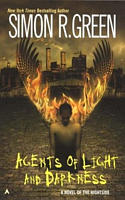
"Agents of Light and Darkness" by Simon Green


The second entry into the Nightside series by Green is just as fast-paced as the first. John Taylor, the man who can find anything, is now living in the Nightside again, and as usual, there are forces who need his help. In this particular instance, he is requested to find the Unholy Grail, the cup that Judas drank from at the Last Supper. Seems it's surfaced and several parties are interested in obtaining it, as it brings great power to the one that owns it.

Of course, it also brings corruption and madness....

John is not the only one racing to find it. Angels from Above and Below are very anxious to procure it, as are several of the Nightside's residents. Indeed, even the Vatican is showing a great amount of interest in this little artifact, and John needs to hurry. The Nightside might not be able to survive this battle otherwise.

There's not much to say about this book, other than you won't be disappointed in it. The only thing that I was surprised about was that I knew who one of the key players was as soon as he/she showed up. Not to worry, though - that didn't mean that I was able to figure out how that character played into things, nor was I prepared for the ending. A great little sci-fi series for those who like Jim Butcher and perhaps the very early Anita Blake books.

"Everyday Cheapskate's Greatest Tips" by Mary Hunt


This is one of those fun little books that you can read in about an hour or two, something that you pretty much skim through and pick out the good stuff. And there is some good stuff in here! Ms. Hunt publishes the national subscription newsletter "The Cheapskate Monthly" and a syndicated newspaper column called "Everyday Cheapskate". Now, before you say "oh no, not another financial guru!", rest assured that Ms. Hunt is not offering that kind of financial advice. No, she serves up easy-to-do, common-sense, home-spun advice, and she knows of what she speaks - at one time she owed $100,000 in debt, and she paid it all off, one penny at a time. No bankruptcy, no fancy accounting, just some hard-nosed decisions and a lot of determination. And in this day and age, when so many of us are in the red, it's refreshing to read about someone who understands our pain and can honestly tell us how to alleviate it, then live in such a way that we don't get right back into it.

This particular book is a compilation of tips, 500 of them to be exact, and they range from little things like cutting your dryer sheets in half to putting aside money every paycheck towards an "emergency fund" (rather than relying on a credit card for just such emergencies). Not all of the tips will apply to everyone, nor will everyone want to follow the advice. For example, the Bookbabe doesn't have children, so I skipped over most of that section. Ditto on the pet section. But that doesn't mean those tips won't be valuable to another reader.

It's worth the short amount of time it takes to get through this book to read it. I pulled out 4-5 tips that I plan on putting into action soon, things that I think might help out myself and the Hubster. You may not find any; you may find all 500 useful. Either way, it's worth a look!