Thursday, May 29, 2008

"Half the Blood of Brooklyn" by Charlie Huston


"There's only so much room on the Island, only so much blood, and Manhattan's Vampyre Clans aren't interested in sharing. So when the Vyrus-infected dregs of New York's outer boroughs start creeping across the bridges and through the tunnels, the Clans want to know why.
Bad luck for PI and general hard case Joe Pitt.
See, Joe used to be a Rogue, used to work off his own dime, picked his own gigs, but tight times and a terminally ill girlfriend pushed him into the arms of the renegade Society Clan. Now he has all the cash and blood he needs, but at a steep price. The price tonight is crossing the bridge, rolling to Coney Island, finding the Freak Clan, and figuring out what's driving that bunch of savages to scratch at the Society's door. No need to look far. The answer lies around the corner in Gravesend. Convenient, all those graves.
From uptown to the boardwalk, war drums are beating. Murderous family feuds and personal grudges are being drawn and brandished, along with the long knives. Blood will spill and, big surprise, Joe's in the middle. But hey, why should this night be different from any other?
Sunset to sunrise: Put off a war, keep your head attached to your neck, and save your girl. Check. Joe's on the case."

Yes, our favorite vamp PI is back. And this time around, Joe is being played by all sides, not just The Society. There's Predo at the Coalition, getting info from Joe not so much by what Joe tells him but by what he doesn't. There's Daniel, enigmatic leader of The Enclave, who tells Joe that he can tell is someone is Enclave just by looking at them. Which means that Joe will end up bringing his AIDS-stricken girlfriend, Evie, to see Daniel, whether she wants to become Vampyre or not. There's the Count, who has been looking for a real cure to the Vyrus; his search is driving him insane. And there's Amanda, a human girl, who wants to start her own "family" of vamps and humans living and working together in harmony. A very rich girl who feels that Joe owes her a favor or two, seeing as how he killed her mother.

Yeah, Joe's getting it from all sides. But by the end of this book, he's going to surprise quite a few people, including me. I was worried that Huston was going to send this one to the trilogy graveyard (pardon the pun); Joe was looking like a man on the ropes and down for the count. I had really enjoyed his other non-vamp work, but didn't care for how that trilogy ended. Luckily, I think Joe Pitt will be coming back to us soon. And the Manhattan Clans? I think they better be prepared...

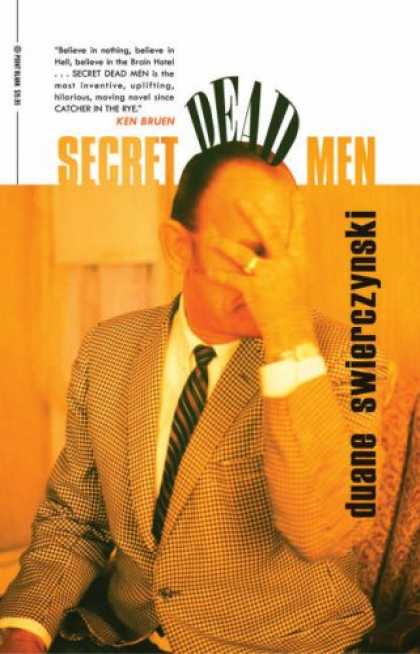
"Secret Dead Men" by Duane Swiercyznski


After reading "The Blonde", I was anxious to find something else by the author to check out. We have a copy of "Severance Package", his newest book, on order, but who wants to wait? So I found myself a copy of an older title, "Secret Dead Men". And after reading it, I'm just not really sure what to think.

This is not one of those logical action sort of books, where point A leads to point B leads to a neatly wrapped package of an ending at point C. I would most definitely call this a mind-f**k of a book. It's interesting in a "what the hell is going on here?" kind of way. And it's short, clocking in at just under 200 pages, so it's not as if it takes forever to reach the end.

Detective Del Farmer has an unusual ability to collect souls, often consulting with them after their deaths to help solve their murders. He's got an elaborate "Brain Hotel" in his mind where he compartmentalizes his souls, giving them the opportunity to have a bit of a life after their deaths. He even relies on them at times to take over his body to perform certain parts of the investigation. It's all been going fairly well until now. This last collection has become a complete fiasco, even though it may finally lead Del to the mysterious Association, the super-secret group he was investigating when he himself was killed. Yes, that's right - Del is actually a collected soul as well. After his collector, Robert, decided to "move on", Del was left in charge of the collecting - and the body that Robert was using. Del Farmer was incinerated in a car fire by The Association, thus his need for closure (and possibly revenge).

Del has gone to Woody Creek to investigate the death of one Brad Larsen, a professor in the Federal Witness Protection program. He "collects" Brad, who tells Del that he'll help him track down The Association (he has inside knowledge) if he will in turn help Brad get even with his killers. Brad's wife, Alison, was also at the remote cabin and now lies dead on the floor, something that is devastating to Brad when he finds out. Del agrees to the deal. But is Brad really who he says he is?

It's hard to say. There's Del, there's the characters "living" in Del's brain, there's the killers, there's a possible robot, and a whole lot more. As I said in the into, this is one weird book, but I liked it. It's a bit hard to follow at times, especially the leaps from "reality" to the internal world of the Brain Hotel. It does make sense in a strange kind of way, but you have to be willing to go along for the ride. Do NOT try to use logic on this book!

Thursday, May 22, 2008

"Vampire Hunter D" by Hideyuki Kikuchi


This is the one that started it all, I guess. But having read this book, I cannot for the life of me understand why I loved the movie so much. Perhaps the film editors worked on the dialogue some, or jettisoned extraneous characters. In any case, if you ever watched that piece of anime from the 80's, keep that memory for yourself. The book isn't really what you're hoping for.

On the other hand, the book does give a bit of D's back story, if you couldn't piece it together for yourself. Moreover, it gives quite of bit of the history of the world in 12,090 A. D., something I don't remember the moving doing, which was helpful. Not enough to save the book, though.

The story is basically that a young girl of 17, Doris Lang, has been bitten by a vampire, the dreaded Count Magnus Lee. She's in search of a vampire hunter to kill the Lord; if that's done before the Count can completely turn her, she'll go back to being a normal human again. Doris and her younger brother Dan live on a farm on the outskirts of town; their parents, both Hunters, were killed a few years ago. Enter D, who accepts Doris's offer (although not completely). He becomes a bit of a big brother to Dan, making it all the more painful when he must move on at the end of the book. No, that is not a spoiler; there are at least 11 more volumes in this series, so you know D goes on to have more adventures.

There are a lot of characters to keep track of in this first installment, and I really didn't see all of them as necessary to the plot. Also, there is little to no character development, perhaps not all that surprising when one considers the manga origins of this translation. However, to say that a graphic novel is merely a flat comic is doing a grave disservice to such works as "Sandman", etc.

I myself will not be searching out any more of the Vampire Hunter D books. I prefer to remember the Vampire Hunter D of the movie; he was truly a work of art.

Tuesday, May 20, 2008

"The Big Squeeze" by Steven Greenhouse


If you've ever had an ogre for a boss, have ever felt completely unappreciated, or have ever been told "work smarter, not harder", then this book is for you. Especially if you're one of the myriad of American workers who are working for minimum or near-minimum wages. I saw some reviews of this book in a professional journal and really wanted to take a look at it. Now that I'm done with it, I have to say that it was probably one of the most depressing books I've ever made it through.

Mr. Greenhouse is definitely on the side of the little guy. In the first eight chapters he details such workplace violations as employees being forced to work off the clock, having their hours "erased" by supervisors, being locked in their businesses overnight, etc. Wal-Mart is, of course, one of the worst offenders and Mr. Greenhouse uses example after example to let the reader know just how bad this company has gotten. True, they have made a few efforts to fly the straight and narrow lately - but only after being dragged into court several times for said violations. Just in case you thought it was only the lowest of employees getting the shaft, the author also details how those trying to rise through the ranks must turn on their once-fellow employees, spying on them and being forced to find ways to either cut hours to make payroll or working off the clock themselves to get jobs done.

Thank goodness Chapter 9 is about companies that do things right; I wasn't sure I could take much more of the doom and gloom of the first chapters! Costco, Patagonia, Cooperative Home Care and the Culinary Workers Local 226 of Las Vegas are upheld as the sort of companies that can and do exist, ones that not only make profits but treat their employees well. And guess what? Those employees stay, saving the companies additional monies in hiring and training fees. It's something that those on Wall Street should really learn - happy workers are productive workers who work for a company long-term.

Perhaps the best thing that I read in this work was a maid who actually stood up to her boss. Ercilia Sandoval was working as a cleaner in Houston when the incident happened. Ercilia is an illegal, one of the many groups that can be exploited for cheap labor. The fact that she stood up to a tyrant boss who was mistreating another employee floored me; I don't know that I could've done it, fearing deportation and all. Here's a bit of the incident described in Ercilia's own words:
"One coworker from Honduras, she was cleaning floors, and the supervisor grabbed the bag with the worker's cleaning chemicals and threw them on the floor. She said, 'Pick them up.'
The woman started to cry, and I got involved. I asked, 'Why are you bothering her? If you're a supervisor, why don't they give you a talk on how to treat workers?' She said, 'Don't get involved. I'm not talking to you.'
I said, 'I know you're not talking to me, but just because you're a supervisor doesn't mean you should abuse people.'"
You go, Ercilia!

So what sort of solutions does Greenhouse offer up? Raising the minimum wage, or possibly enacting legislation guaranteeing workers a "living wage". Also, the author is pretty big on unions, which I'm not so certain I agree with. I think they can have their place, but I also think they've hurt workers in some areas by making demands that are unrealistic, as well as refusing to agree to any company requests when things aren't going well. The author is also probably pretty on-target when he laments the demise of pensions; there are a lot of people out there who either don't enroll in 401k programs or don't understand what to do once they're in them. But pensions aren't necessarily the answer either.

In the long run, the only thing that will elevate employees again and make it possible for the middle-class to thrive is respect. Employers need to respect their employees as human beings and treat them well, even if they can't pay them much. In turn, employees must respect their employer by giving 100% when they're on the job (honestly, you know that there are people out there taking advantage of their companies just as the companies take advantage of others!) I don't know if Americans will ever be as affluent as they once were. And reading this book certainly didn't help my convictions any. But it is important to talk about this issue, and I think Mr. Greenhouse has done a good job with it.

Saturday, May 17, 2008

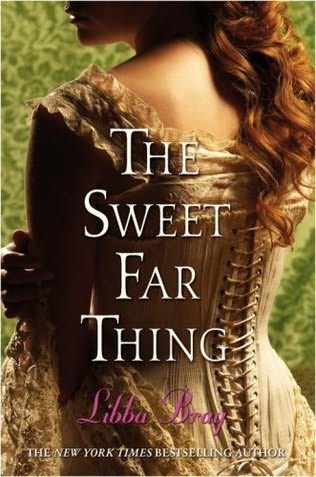
"The Sweet Far Thing" by Libba Bray


The best thing about this book isn't actually the book itself; it's the acknowledgments section at the very beginning written by the author. How sad is that? This also marks the first time I've done two things - I gave up on a book long after I passed the 50 page stopping point, and I found out how it ends by reading some discussion threads on Amazon.

I won't try to bore you with a description of the book, and I won't ruin the ending of it for you if you're so inclined to read it. Suffice to say that it took me over 3 weeks to slog my way to page 321, and the book is 819 pages long. I don't know if the author suddenly thought she needed to describe more of the historical events of that time or not, but there's a lot more exposition about the Spence girls and their debut into society than there is about Gemma, her abilities, and the magic she now holds. I wanted Ms. Bray to get on with the story, but it seems she decided to get bogged down with details.

After I'd made the decision to pretty much give up on this book, I went to Amazon and read quite a few of the reviews there, as well as some of the posts on the discussion threads. As I suspected, this book did not end well ("well" being a subjective term, I know!). As I said, I won't spoil it for anyone else, but I will say that if I had somehow made it to the bitter end, it would've been exactly that - bitter. In a way, I'm glad I gave up. I'd rather remember the enchantment of the first two books in this series than go and spoil all that with the ending of this installment.

Tuesday, May 13, 2008

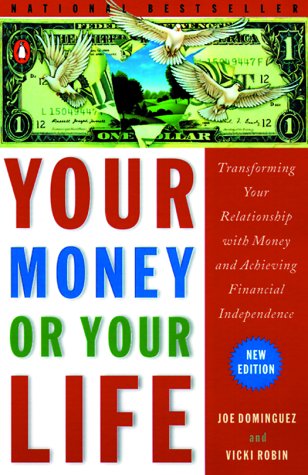
"Your Money or Your Life: Transforming Your Relationship with Money and Acheiving Financial Independence" by Joe Dominguez and Vicki Robin


In these tough economic times, I thought this book would be a very enlightening (and hopefully helpful) read. "Your Money or Your Life" is supposed to be one of the Holy Grails of financial advice; pick up any other book about how to cut your bills, save money, etc, and chances are very good that you'll find this title listed in the bibliography.

I was really hoping for some wise insight here. With gas running almost $3.75/gallon, milk over $4/gallon, eggs up to over $2/eighteen, etc, I could really, really use some wise advice on how to cut corners and still be able to have a life and put money into savings. Well, this book would be great for those who have never really had to scrimp and save, or perhaps for those who were never really taught about how credit works, interest rates and such being what they are now. But for someone like myself who grew up knowing the value of a dollar, there's not a whole lot that's new here.

The authors pretty much advocate the "live below your earnings" principle, which is what we all should have been doing all along. But in our society of rampant consumerism, most of us have been living above our means and using credit cards to do so. Those accounts have to be paid at some point, whether you pay them off each month or just barely make the minimum payment. And the less you do pay on them, the faster your balance goes up and the more you have to work to just get by. What the authors want people to do is to pretty much stop and think about each purchase; it's good advice in my opinion. "Conscious spending" should go hand in hand with "conscious eating", "conscious relationship-ing", etc. We spend so much of our time thinking about the future rather than living in the here-and-now. Think about it - when was the last time you truly listened to your spouse/children/co-workers? When was the last time you spent time saving up your pennies to make a purchase? When was the last time you sat down to eat that you had the TV turned off? We don't appreciate the things we do have, so we go out and try to buy our way to happiness.

Doesn't really work, does it? That's what the authors are trying to tell us. They also point out that a high-paying job may not really be the answer if you have to spend more on clothing/gas/items you buy to de-stress from said job. This part of the book I could totally relate to! I worked in an office, a "real job", for around 6 years; by the time I left I was miserable. I hated the job, didn't like the people I worked with, and spent money to try to "cheer" myself up. When I finally left, I went to work for a used book store making about half of my previous salary - and loving every minute of it. Sure it was scary at first, but what was really surprising was how easily I adjusted to that new lower income. I took my lunch to work, could wear jeans/T-shirts, and only had to drive about 10 minutes away rather than 30 minutes into the downtown area. I was doing something I really enjoyed and working with people who liked and respected me. The authors are very correct to encourage people to "look outside the box" when it comes to thinking about earning a living; the best job for you isn't necessarily a 5-figure job.

The other point they made over and over that I really liked (and truthfully hadn't thought much about) was that we all have jobs, whether we are actually working for a paycheck or not. This is very important; too many of us define ourselves by our career path, rather than who we actually are. We are not just clerks, cashiers, accountants, etc; we are also husbands and wives, parents, best friends, caregivers, housekeepers, etc. Those are all very valid jobs - we just don't earn a paycheck for them. It doesn't make them, or us, any less important. Very good advice to keep in mind the next time you're downsized!

As for their financial advice, well, it's pretty much what we've been told over and over - don't overspend, pay yourself, and stop buying so much "stuff". Their plan for financial independence was shocking, though - BONDS. Yes, once you have your debt paid off and your 6-months cushion in the bank, you should run out and use the rest of your savings/extra income to purchase U.S. Treasury Bonds. WHAT? I mean, they're not a horrible investment, but they certainly aren't a great one, either. They are, I suppose, very safe; perhaps that's the appeal to the authors. But they certainly wouldn't be my first or only choice!

Overall, this isn't a bad read and there is some good advice. I don't think it's the "answer" to every one's financial problems, though.

"A Streetcar Named Desire" by Tennessee Williams


I know I saw this movie once upon a time, but it must not have made that much of an impression on me; reading the play was like coming to the story for the first time. Oh sure, I did remember the famous (or infamous) scene of Brando with his torn shirt yelling "Stella!" at the bottom of the staircase, and the last line by Blanche about relying on the kindness of strangers. But the overall guts of the play? Not so much.

In case you've never read or heard of it, Williams' play takes place in New Orleans and illustrates the differences between two sisters, both of whom were raised as "Southern belles". Blanche still maintains that she is that polite, genteel Southern beauty, despite a setback here and there, while her baby sister Blanche has married Stanley, a hard-working, hard-drinking guy who is anything but genteel. When Blanches comes to visit Stella, she is shocked and appalled at the "squalid" conditions she finds, almost as much as she is by Stanley's blatant sexual nature. Blanche maintains that she is still mostly a non-drinker and that she's just had a bit of bad luck, thus her "extended" stay at her sister's.

Stella may have her suspicions about her older sister, but Stanley knows exactly what is going on. He knows that Blanche is not even remotely what she claims to be; she definitely has a drinking problem, and she's not nearly as "virginal" as she pretends to be. Stella may have grown up on the plantation, but she's now firmly rooted in the reality that is New Orleans. She loves Stanley and he loves her, something that Blanche seems blind to.

The play basically follows the family members through a summer at Stanley and Stella's apartment. It's fairly obvious from the start that Blanche isn't playing with a full deck, or at least, it was to me. She's been traumatized by the long-ago suicide of her husband, she's drinking way too much, and there's the fact that she was left behind to deal with the deaths of their parents as well as several close relatives, deaths that required funerals and payment for said funerals. Blanche has lost the family home; she's broke, out of work (thanks to what appear to be possible affairs with students at the school where she taught), and has been thrown out of the seedy hotel where she was living "back home". It's interesting to watch the two sisters cope with their lives; Stella has learned how to adjust and adapt to her new surroundings/fortunes, while Blanche is basically stuck in the past.

Of course, this being a work of Williams', there's not really a happy ending per se. Blanche and Stanley have an "encounter" which results in her being sent to an asylum. I wasn't sure how to read that scene; Stanley either rapes her or merely has rough sex with her. Given Blanche's true nature, it's hard to believe that it's rape. Indeed, Stanley says something to the effect that it's inevitable what's about to happen between them. The only thing that did bother me was that it also appears that Stella knows what happened - and doesn't seem to care. Or maybe she's just better at hiding her feelings than Blanche. Either way, it's not a pretty picture.

I would definitely recommend you check this out if you're not familiar with the story. It's an interesting play, one that I will probably read again down the road; I'd be interested to see if I catch things/interpret things differently next time.